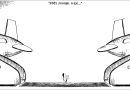
THE veritable show of China’s military might on the eve of recently held SCO summit endorses the very importance of the Chinese power at the global level.
China is attempting to rebalance the global order by reducing US and Western dominance and promoting a “multipolar” world with China at its centre. Glaringly, through various initiatives, China is creating alternative institutions, expanding its global influence and exporting its model of state-centric governance. Beijing directly challenges Western liberal norms and promotes its own state-centric governance model. Chinese leaders argue that countries should not impose their values on others, while pushing for a system that respects diverse political systems. The Chinese tapestry of world order is systematically based on its institutional power, strategic prowess, thinking and cultural power, fostering the basis of its both soft power and hard power dynamic.
Rules-based vs. liberal order: Since the end of the Cold War, Beijing has been systematically trying to establish its both political and economic norms, characterizing the new world order where Beijing emerges as a trans-regional economic hub of global power. In this way, China aims to replace the US-led “liberal international order” with a “rules-based order” where it can use rules to its contribution towards global advantage. Subsequently, in contrast to the Western emphasis on free markets and human rights, this allows Beijing to operate more freely and to push back on criticisms of its policies Military expansion:
Chinese firepower: As demonstrated by a major military parade in September 2025, China has projected its growing military power on the world stage. This display is intended to signal Beijing’s ability to assert hard power and challenge US military pre-eminence, particularly in the Indo-Pacific. In this regard, China is deepening military and diplomatic ties with countries like Russia and Iran that also seek to challenge the US-led order. Needless to say, the basic components of modern Chinese firepower are organized around a multidomain, precision-strike capability that is integrated across its services. This approach, known as “Multidomain Precision Warfare” (MDPW), uses kinetic and non-kinetic means to target and paralyze an enemy’s command and control systems.
Community of shared future for mankind: President Xi Jinping promotes this concept as a way to replace Western liberal norms with a system emphasizing national sovereignty, non-interference and shared benefits. This vision is aimed at appealing to countries dissatisfied with the US-led order. The core principles of China’s “Community of a Shared Future for Mankind” are aimed at building a world of lasting peace, universal security and shared prosperity. The vision calls for countries to work together and overcome challenges by applying the common values of humanity.
China’s Global initiatives: China has launched the Global Development Initiative (GDI), Global Security Initiative (GSI) and Global Civilization Initiative (GCI). These platforms offer a Chinese-led framework for addressing global issues, creating alternatives to existing, Western-led approaches. China’s global initiatives are driven by multiple underlying objectives, which often combine China’s national interests with broader international rhetoric. While presented as cooperative and beneficial for a “community of shared future for mankind,” these initiatives ultimately serve to advance China’s economic, political and strategic influence on the world stage.
The core of China’s strategy: China focuses on establishing alternative organizations to challenge and reshape the Western-led liberal international order, reflecting China’s growing power and its distinct vision for global governance. While China participates in existing international institutions like the UN, it also creates alternative structures to gain influence, align international rules with its interests and offer new options to developing nations.
Key drivers and objectives of China’s strategy: 1-Creating a multipolar world: China seeks to replace the US-dominated global order with a new system that is more “democratic, just and rational”. By building diplomatic coalitions, particularly within the Global South, China presents itself as a leader of non-Western countries. 2-Belt and Road Initiative (BRI): This is a key mechanism for proposing an alternative economic system based on cooperation with the Global South. It provides a market for Chinese companies, facilitates resource acquisition and expands China’s influence. 3-Asian Infrastructure Investment Bank (AIIB): This was initiated by China to help finance infrastructure projects, address Asia’s development needs and strengthen its own position as a global economic power.
Therefore, Beijing is strengthening existing bodies like the Shanghai Cooperation Organization (SCO), as shown by the high-profile SCO summit in September 2025, where China and Russia pledged a new global order. China also leads other groups, including BRICS, to unite developing countries against what it calls Western “hegemony”. The alignment between Beijing and Moscow is significantly changing the global order by challenging US and Western influence.
Notably, the SCO summit in Tianjin in September 2025 served as a platform for Beijing and Moscow to promote their vision of a new international order. China and Russia are the key drivers behind the SCO’s expansion and initiatives, using it to challenge Western influence and establish alternatives for global governance. Deepening ties with the Global South: China and Russia are actively working to unite countries in the Global South by presenting their partnership as an alternative to the West-led order. During his meeting with Russia’s Foreign Minister Sergei Lavrov, Chinese President Xi Jinping stated that Beijing and Moscow should work to create a more “just and reasonable” global order.
To conclude, the essence of China’s rebalancing shift of global order is a multifaceted, long-term strategy to supplant the US-led, Western-centric system with a more multipolar framework that better serves its national interests. Beijing aims to reshape, rather than dismantle, global institutions and norms to reflect a new global power distribution, fostering a “multipolar” world with a greater role for China, Russia and the Global South. This shift is happening through coordinated diplomatic, economic military initiatives norms.
—The writer, based in Pakistan, an independent IR & International Law analyst, also an expert in Conflict and Peace Studies (with special focus on Palestine, Kashmir), is member of European Consortium of Political Research (ECPR), including the Washington Foreign Law Society/American Society of International Law.