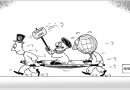
Urban Bystander
They say a capital is born the day its roads learn the difference between leaving and arriving.
Ours learned the steps, framed the hills, and called movement a civic virtue. Then winter returned, marching fever, summit cough, northern itch, and virtue was parked behind containers.
“Seasonal epidemic,” coos Babloo above junctions that no longer believe in geometry. “No vaccine,” Mynah sighs, “only VIP movement.” Mirza Chughal Khor, the famed bureaucrat emeritus, signs the file: Crisis contained, mobility postponed. On every channel the State Minister of Interior performs his favourite verb, threaten. By dusk his words harden into infrastructure: barricades at Margalla, containers at Faizabad, barbed wire around our patience.
He is already running when the city remembers it has walls, containers, barricades, razor wire. A father cuts across the median with a sleeping child who is not sleeping, cheek hot on his shoulder. The road ahead is a red alphabet of STOP. He asks the steering wheel for mercy; it answers with steel. He leaves the car where hope runs out, gathers her tighter, and sprints, between shields and whistles, over stripes that are not bridges.
A bike rider noses a seam through stone with a horn and a prayer. Ambulance on foot, mutters Babloo, then circles back with a citizen’s thought: place ambulances at the blockades so no father must outrun his city. City recommends running, Mynah adds, while Mirza notes: Public safety achieved; mobility in escrow. Step, breath, until a gate remembers how to open.
Morning belongs to a paper and a promise. A boy in a neat shirt ties his courage; his father checks the route like a rosary. First turn: steel. Second: pardon. Third: a policeman who shrugs with his eyes. A Bykea rider glides in, says bismillah without moving his lips, and threads the child through a maze designed by committees that mistrust arrival. The mother keeps the kettle at a tremble; by Maghrib, ink on fingers, the boy walks back in. The kettle clicks. The house breathes.
On the median, Constable Tufail adjusts a dented helmet that has seen more policy than pay. His duty is to ensure flow, which here means stand still and collect insults. Today: one shoulder bruise, two nods to trapped ambulances, three meals postponed. “People think we are the wall,” he says. “We are the hinge.” He waves another motorist toward a closure pretending to be a detour. Tonight, he will go home the long way, because home is always on the other side of a promise.
The minister and the ministry share one disinfected tongue. Closure becomes pre-emptive mobility. Jam becomes high volume affirmation. Blackouts reduce rumour congestion. When the hordes finally arrive, the chest thumping goes off air; only the containers keep talking. Mirza enters the daily line: Flow certified in spirit, archived on site. Stamped Resolved, meaning tomorrow.
By afternoon the capital is a museum of movement, rows of parked intentions labelled Soon. The cure never changes: more barriers, new acronyms, task forces fluent in delay. Night spreads over prayer-mat hills as he pockets a whistle that never moved a container. Overhead, Babloo circles low, reading the city’s vitals, barriers rising, breath thinning. Mynah glides beside him, whispering that travellers should have left yesterday. And far below, Mirza closes his notebook, murmuring that every destination has been quietly deferred.
Islamabad still aches, which is proof of life. But proof is not living.
A city that barricades faster than it breathes will forget which side of the wall its citizens belong to. The minister will call that order; Babloo will call it tragedy. Until someone learns the difference, we will keep perfecting our new civic art i.e. how to carry a child through a capital and deliver a paper through a maze.
The writer can be reached at [email protected]