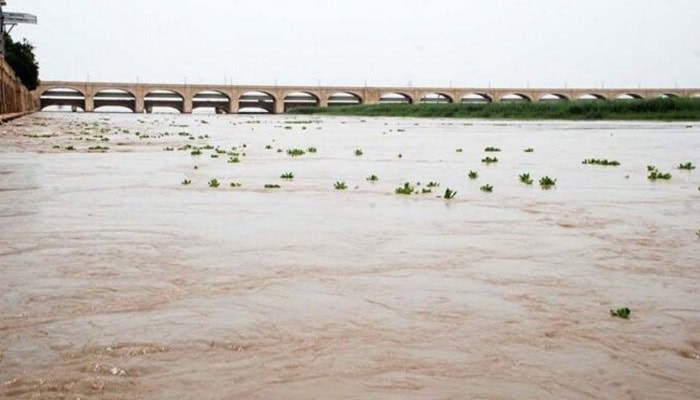

MULTAN – A high-level flood situation has emerged across key regions of Punjab and Sindh, as water flow continues to rise in the Indus River and its major barrages.
The flood has already begun displacing large populations and putting pressure on critical infrastructure.
At Guddu Barrage, a major entry point into Sindh from Punjab, water inflow has reached 425,000 cusecs, with an outflow of 416,763 cusecs, placing low-lying areas of Kashmore district in the danger zone. The authorities have renewed evacuation appeals to residents in these vulnerable katcha (riverine) areas.
Further upstream, Kot Mithan is witnessing a rapid rise in water levels. A mass migration toward safer ground is underway, as administration officials urge people to vacate flood-prone zones immediately.
In Sindh’s Kirthar Range, continuous rainfall has triggered flash floods in local streams, raising further concerns. Sindh Irrigation Minister Jam Khan Shoro stated that no protective embankments will be breached, assuring that preparations for a “super flood” are complete. Despite the government’s readiness, projections indicate that between 150,000 to 200,000 people may be affected in the province.
Water levels at key barrages:
Guddu Barrage:
Inflow: 425,000 cusecs
Outflow: 416,763 cusecs
Sukkur Barrage:
Inflow: 352,000 cusecs
Outflow: 329,310 cusecs
Kotri Barrage:
Inflow: 235,243 cusecs
Outflow: 231,763 cusecs
Panjnad Barrage:
Inflow/Outflow: 524,765 cusecs
Trimmu Barrage:
Inflow/Outflow: 531,993 cusecs
According to the Provincial Rain and Flood Emergency Monitoring Cell, these figures point to a sustained high flood condition throughout the system.
Pressure mounts on Multan
Director General of Punjab’s Provincial Disaster Management Authority (PDMA), Irfan Ali Kathia, warned that Multan is under continuous flood pressure for the last 48 hours, with the next two days being particularly critical.
He explained that excessive flooding across Punjab has slowed down the downstream flow of water, disrupting expected timelines.
“We had anticipated peak water levels at Panjnad by September 4 and entry into Sindh by September 6, but the volume has been overwhelming,” Kathia said.
With 540,000 cusecs of floodwater expected to pass through Multan for the next two days, irrigation officials have taken emergency action along the Chenab River.
Authorities have decided to create a breach at Shershah Bund to relieve pressure, notifying nearby residents to evacuate immediately.