For years, the foldable-phone race has been happening without Apple. That changed today and this is not simply an iPhone that bends. Apple redesigned the device around a book-style folding form, giving users a conventional smartphone on the outside and a huge iPhone display when it opens.
The result is Apple’s most radical iPhone design change in years, but that leap comes with a price tag to match. iPhone Duo starts at $1,999, making it one of the company’s most expensive consumer devices.
Apple Duo
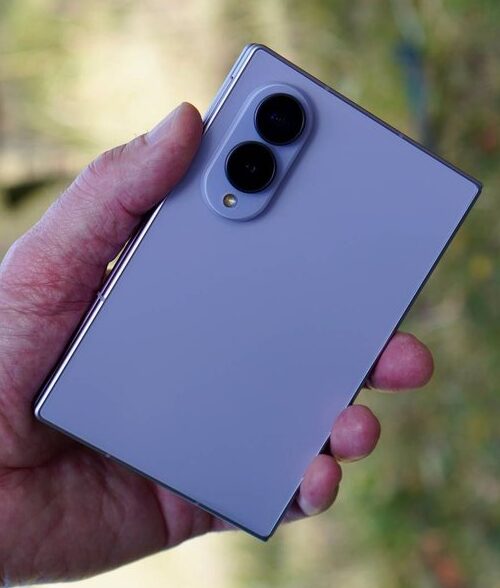
The first thing likely to grab attention is the Duo’s size. When opened completely, the foldable is only around 5.2mm thick, making it the thinnest iPhone Apple has ever produced. Folded, it measures approximately 11.3mm.

The phone weighs around 254 grams and uses a Grade 5 titanium frame, with titanium components also incorporated into its hinge structure. Apple designed the hinge to provide a smoother folding action while improving durability.
The device also gets Ceramic Shield protection and an IP68 rating for water and dust resistance. Apple is offering the Duo in two finishes, Star White and Night Sky.
iPhone Duo Specs
Close the phone and users get a roughly 5.4-inch Super Retina XDR OLED cover display. Open it, however, and the device transforms into a massive 7.6-inch internal OLED screen. Apple says the inner panel is the largest display ever fitted to an iPhone.
Both screens support ProMotion up to 120Hz, Always-On functionality and peak brightness of around 3,000 nits. Apple has also spent considerable effort trying to make the folding screen feel less like a traditional foldable. The inner display uses a nano-texture finish designed to cut down reflections and glare.
A specially engineered display stack and adhesive system are intended to make the crease less noticeable, with Apple aiming for what it describes as a more perceptually flat screen.
Apple Pencil support is coming to both displays later this year.
Face ID is gone, Touch ID makes a comeback
Apple has made an unusual biometric decision for its first foldable. iPhone Duo does not use Face ID. Instead, Apple has brought back Touch ID, built directly into the side/power button. Apple Watch unlocking is supported too.
The inner selfie camera sits beneath the display, while the outer screen has a conventional front-facing camera. Duo is also eSIM-only worldwide.

The foldable may be dramatically different on the outside, but internally it remains a flagship. Apple has equipped the Duo with the same A20 Pro chip used in the iPhone 18 Pro lineup. Built on a 2nm process, the chip features a six-core CPU, a seven-core GPU and dual Neural Engines with a combined 32 cores.
Apple claims graphics performance could be around 30% to 40% faster than the previous generation. The device also uses Apple’s C2 modem. Because the phone is extremely thin and packs two screens into its body, Apple has developed a larger vapor-chamber cooling system to help control temperatures during demanding workloads.
Two cameras not Three
iPhone Duo does not get the full triple-camera arrangement found on the Pro models. Instead, Apple has equipped it with two rear 48MP cameras. The system combines a 48MP Fusion main camera with a 48MP ultrawide.
There is no dedicated telephoto lens. The camera system nevertheless supports macro photography and 2x optical-quality shooting modes. Apple has also created several features specifically for the foldable form factor.
The outer display can also act as a preview window, making it easier to take selfies or group photographs using the main camera. A new Smart Take feature can automatically capture a shot when the system detects that people are ready to pose.
Center Stage is also included. Both front-facing cameras are rated at 12MP, with the internal camera positioned underneath the display. The battery could be one of the Duo’s biggest strengths Apple has fitted the Duo with a dual-cell battery system.
The company claims around 24 hours of mixed or typical use. Video playback can reach approximately 31 hours on the inner screen and up to 44 hours using the outer display. Charging is also getting faster, with wired charging reportedly capable of reaching around 50% in approximately 20 minutes.
iPhone Duo’s biggest advantage may not be its cameras or thinness. It could be the way iOS behaves when the phone is opened. Apple has optimized iOS 27 for the larger internal screen, allowing applications to expand and adapt as the device folds and unfolds.
Users can run apps side by side, access a redesigned vertical dock and use expanded controls. The phone can also remain partially folded for video calls, watching content and hands-free tasks. In other words, Apple is trying to make the Duo feel like an iPhone when closed and something much closer to a small iPad when opened.
iPhone Duo price will turn heads
The foldable starts at $1,999 for 256GB.
Higher storage options are expected to cost:
- 256GB — $1,999
- 512GB — $2,199
- 1TB — $2,599
- 2TB — $3,199
Apple will begin taking pre-orders on October 16, with the first units reaching customers and stores on October 23.
Additional markets are expected to receive the foldable from October 30.
Apple is also selling dedicated accessories, including a standard case for around $79 and a Folio case with a kickstand for approximately $129.
iPhone 18 Pro and Pro Max
While the Duo was undoubtedly the star of the night, Apple also introduced its conventional flagship models — the iPhone 18 Pro and iPhone 18 Pro Max. The design remains familiar, with around 6.3 inches of screen on the Pro and 6.9 inches on the Pro Max.
Both use Super Retina XDR OLED displays with ProMotion up to 120Hz, Always-On functionality and peak outdoor brightness of around 3,000 nits. The colour lineup includes black, silver, glacier and burgundy.
Apple has also made the Dynamic Island smaller while retaining support for up to three Live Activities.
48MP cameras
The biggest camera change is the introduction of a variable aperture on the main Fusion camera. The mechanical system can move between several aperture settings, broadly ranging from ƒ/1.48 to ƒ/4. That gives photographers more control over light, depth of field and background blur. The ultrawide and telephoto cameras have also moved to 48MP, with the telephoto system offering around 4x optical magnification.
Apple has improved Photographic Styles, added additional Pro Controls and introduced Reference Image, a feature intended to help establish whether an image is an authentic photograph rather than AI-generated content.
The front camera has also been upgraded to around 18MP. Advanced video features including 4K, ProRes and Log remain available.
Pro models run on Apple’s A20 Pro chip, manufactured using 2nm technology. Apple claims graphics performance improvements of roughly 30% to 40%, while a redesigned vapor chamber helps maintain performance during demanding tasks. Battery life has also improved.
iPhone 18 Pro is rated for around 24 hours of typical use and up to 36 hours of video playback. Pro Max reaches approximately 30 hours of typical use and 45 hours of video playback. Fast wired charging can reportedly reach around 50% in 15 minutes.
Storage starts at 256GB and goes up to 2TB, with around 12GB RAM expected.
iPhone 18 Pro prices
iPhone 18 Pro starts at $1,199, while the iPhone 18 Pro Max begins at $1,299, both for 256GB. That is roughly $100 more than the previous generation.
Pre-orders begin September 12 at 5 a.m. PT, with availability starting September 18 in initial markets.
Perhaps one of the strangest parts of Apple’s event was the absence of the phone millions expected to see.
There was no standard iPhone 18.
Apple also did not announce the expected iPhone 18e or next-generation iPhone Air.
Those models are now expected around spring 2027.
Memory and component shortages are reportedly among the reasons behind the change, while Apple’s push toward premium, higher-margin products could be another major factor.
iPhone 18 Pro price goes up by Rs28,000 as Apple Launches New Flagship