
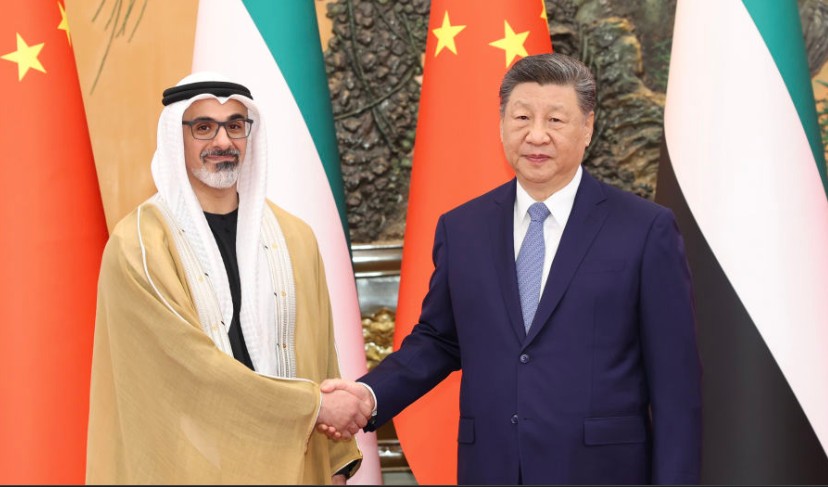

BEIJING – Chinese President Xi Jinping brings sweeping four-point proposal aimed at reshaping peace and stability efforts across the Middle East and Gulf region during talks with UAE Crown Prince Sheikh Khaled bin Mohamed bin Zayed Al Nahyan.
The proposal, presented during their high-level meeting, outlines a comprehensive framework centered on long-term regional stability and cooperation. Xi first emphasized the principle of peaceful coexistence, calling for the creation of a shared, comprehensive, cooperative, and sustainable security architecture that could guide security relations across the Middle East and Gulf states.
He also strongly stressed respect for national sovereignty, insisting that the sovereignty, security, and territorial integrity of all regional countries must be fully upheld. In addition, he highlighted the importance of safeguarding the safety of personnel, infrastructure, and diplomatic institutions belonging to all nations operating in the region.
A key pillar of the proposal focused on reinforcing the authority of international law. Xi warned against a return to what he described as a “law of the jungle,” urging countries to uphold global legal norms and maintain an orderly international system.
Finally, he underscored the need to align development with security, arguing that both must advance together. According to him, regional states should cooperate to build a stable environment that supports economic development and long-term prosperity throughout the Middle East and Gulf region.


