Ijaz Kakakhel
Islamabad
To cover the gaps in some previous years, President Asif Ali Zardari’s recent visit to China has further deepened strategic cooperation, more bilateral economic ties in different areas of economy.
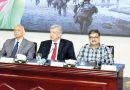
Pakistan People’s Party leader Senator Saleem Mandviwala expressed these views during a press conference in president house. He was accompanied by the President Spokesperson Murtaza Solangi. Saleem Mandviwalla said that the president’s visit was aimed at strengthening business-to-business ties and fostering public-private partnerships across a a range of sectors.
He said this was President Zardari’s second official visit to China since assuming office. However, he said that unlike the first visit when the president met with the top Chinese leadership, he focused on mid-level Chinese leadership, engaging extensively with provincial governors and Communist Party officials to promote investment and cooperation.
President Zardari witnessed the signing of six key agreements with various Chinese institutions in areas including transportation, waste management, energy, education, and agriculture.
President’s spokesperson Murtaza Solangi highlighted that while President Zardari’s first visit included meetings with China’s top leadership, including President Xi Jinping, this visit deliberately focused on provincial-level engagement. “The President visited Shanghai, Urumqi, Kashgar, and Sichuan, covering a broad spectrum of sectors such as agriculture, public health, biotechnology, food security, transportation, and education,” he said.
One of the most notable aspects of the visit, Solangi noted, was the unprecedented presence of Chinese Ambassador to Pakistan Jiang Zaidong, who accompanied President Zardari throughout the tour on instructions from Beijing which reflected the level of bilateral relationships.
Saleem Mandviwala underlining the historic nature of President Zardari’s visit to Kashgar, making him the first Pakistani head of state to do so said that the visit came at the invitation of the Chinese government.
He also termed the president’s tour of the Aviation Industry Corporation of China a milestone, noting that Zardari became the first foreign head of state to be invited to the AVIC complex. The president was briefed on China’s latest aerospace capabilities including the J-10 fighter jet, JF-17 Thunder co-production, J-20 stealth aircraft, UAV technologies, and multi-domain command-and-control systems.
“This visit could pave the way for future agreements for the procurement of advanced defence technologies from China,” Mandviwala added. Among the key outcomes of the visit was the signing of a Memorandum of Understanding for the establishment of a Coal Gasification and Fertilizer Plant in Thar, Sindh, the first of its kind to utilize Thar coal. This project is expected to address energy needs while supporting Pakistan’s agriculture sector.
The president also witnessed the signing of three additional MoUs focused on modernizing Pakistan’s livestock industry, construction of a modern textile industrial park, and supply and after-sales services for fire trucks and emergency equipment, Mandviwalla said adding that another agreement was signed for waste and tyre recycling in Karachi, while President Zardari also experienced China’s high-speed rail network, expressing his desire to see similar technology adopted in Pakistan.
As regards the China-Pakistan Economic Corridor, Mandviwalla confirmed that discussions were held to reinvigorate and expand the initiative. To a question, Mandviwalla clarified that the agreements and projects signed during the visit were not limited to Sindh, but were meant to benefit the entire country.