




Pakistan’s military command structure entered new phase after the lower house of Parliament approved legislation introducing sweeping changes to the country’s defence and nuclear command system. The bills establish formal legal framework for the Chief of Defence Forces (CDF), create a unified Defence Forces Headquarters and reshape the legal structure governing Pakistan’s strategic and nuclear command.
But while the legislation could significantly change how the armed forces are commanded, its passage has already triggered a political storm.
The two bills were approved by the federal cabinet on Thursday and introduced in the National Assembly later the same day.
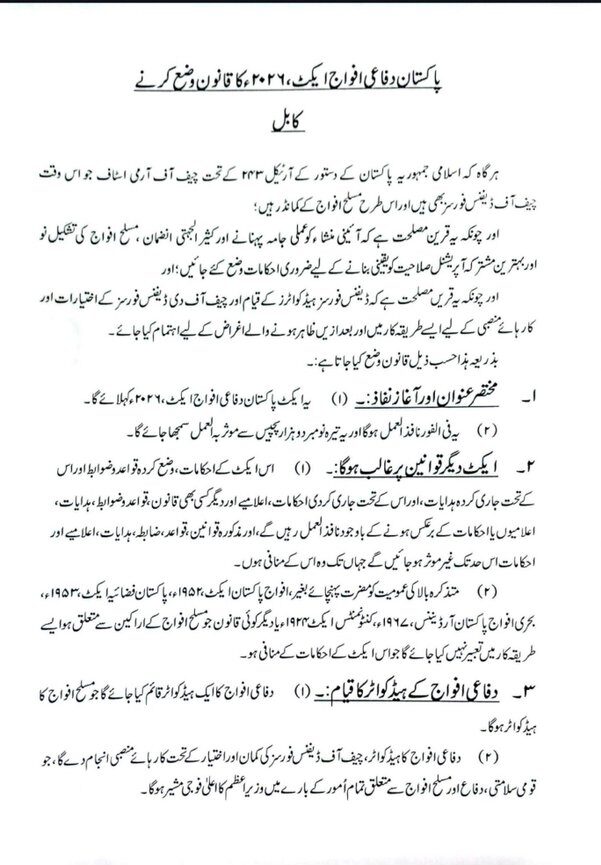
Defence Forces Act 2026
The biggest change comes with the legal establishment of the Chief of Defence Forces. Defence Forces of Pakistan Act provides CDF with command responsibilities over the country’s armed forces and establishes a new Defence Forces Headquarters.
The headquarters will serve as the central command structure for the armed forces and will operate under the CDF. Chief of Defence Forces will also become the prime minister’s principal military adviser on defence, national security and matters concerning the armed forces. In simple terms, the legislation is designed to bring the Army, Air Force and Navy into a more integrated command framework.
Army, Air Force and Navy to operate under joint coordination
One of the central objectives of the new system is what the legislation describes as multidomain integration and greater jointness. CDF will oversee matters involving all three services, particularly operations or strategic issues requiring coordinated action.
This includes Joint operations involving multiple services, Operational coordination between the Army, Air Force and Navy, Strategic military matters, Multidomain integration, Oversight of issues affecting national security and coordination of activities involving the armed forces collectively.
CDF will exercise operational command and control while remaining responsible to the federal government for command-related matters.
The proposed framework also gives the CDF substantial authority over military personnel.
The office will have powers relating to Retirement, Release from service, Acceptance or rejection of resignations, Discharge, Retention in service, Relaxation of certain age or service limits. However, the legislation excludes officers appointed under Article 243 of the Constitution from these particular provisions.
The federal government can also assign additional responsibilities to the CDF. This means the exact scope of the office can potentially expand through responsibilities prescribed by the government.
Nuclear command structure
The second bill focuses on Pakistan’s National Command Authority Act, which governs the country’s nuclear command system. The reason for the changes is the restructuring introduced through the 27th Constitutional Amendment in November 2025.
That amendment abolished the position of Chairman Joint Chiefs of Staff Committee and introduced the Chief of Defence Forces position alongside the Army Chief. Field Marshal Asim Munir became the first officer to hold both positions.
The constitutional changes also created another powerful strategic position: Commander of the National Strategic Command. The post is held by a four-star officer responsible for integrating Pakistan’s strategic forces. General Syed Amir Raza was appointed to the position in July.
The new legislation is intended to bring the country’s nuclear command laws into line with this newly established military hierarchy.
Taken together, the two bills are one of the most major changes to Pakistan’s military command architecture in recent years. The reforms create more centralised command structure, strengthen the role of the Chief of Defence Forces and establish a unified headquarters for the armed forces.
The nuclear command amendments, meanwhile, ensure that Pakistan’s strategic command system reflects the constitutional changes already made to the broader military hierarchy. In effect, the legislation seeks to make the legal framework match the new command structure.
Defence Forces Act 2026 sails through NA as Pakistan resets Military Command


