


ISLAMABAD – Just as Pakistanis trying to cope with already high fuel costs, OGRA delivered another shock by increasing petrol and diesel prices.
Under the new pricing announced through an official notification, the price of petrol has increased by Rs2.29 per litre, taking it to Rs346.16 per litre.
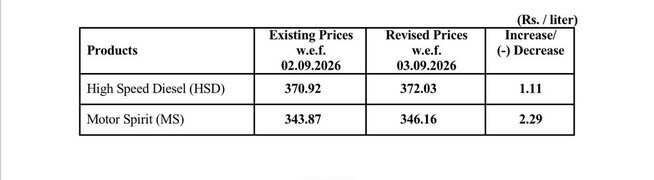
The government has also raised the price of High-Speed Diesel (HSD) by Rs1.11 per litre, bringing the new diesel rate to Rs372.03 per litre. The revised prices have taken effect immediately.
For ordinary consumers, the impact of the increase could go well beyond the fuel station. Higher petrol and diesel prices generally translate into increased transportation costs, which can eventually make their way into fares and the prices of food, goods and other essential items.
The latest increase comes at a time when international oil markets are already facing severe uncertainty due to the continuing U.S.-Iran conflict and concerns over the disruption of global energy supplies.
Oil prices remained volatile on Wednesday, with Brent crude rising 25 cents to $94.90 a barrel by 10:48 a.m. ET (1448 GMT). U.S. West Texas Intermediate (WTI) crude also edged up 10 cents to $90.32 a barrel.
However, the market was far from stable. Both major oil benchmarks swung sharply during the session, moving between gains of as much as $2 a barrel and losses of about $1. Earlier gains had pushed both contracts to their highest levels since July 24.
The volatility reflects growing fears that the prolonged conflict could further squeeze the world’s energy supply. Now in its seventh month, the U.S.-Iran war has seen renewed military exchanges, with U.S. forces striking Iran’s southern coast and Tehran launching attacks on American bases across the region.
The latest confrontation has been described as the biggest exchange of fire between Washington and Tehran since July, keeping global energy markets on edge.
The conflict began following joint U.S.-Israeli strikes on Iranian targets in late February and has since severely disrupted shipping through the Strait of Hormuz, one of the most important energy corridors in the world.
Before the conflict, the waterway carried around one-fifth of the oil and LNG consumed globally. Its effective closure has therefore raised serious concerns over the availability and cost of energy worldwide.
For Pakistan, the international turmoil carries an added risk. As a country heavily dependent on imported fuel, any sustained rise in global crude prices can eventually put pressure on domestic petroleum rates.


