TEHRAN — Iran appears to be rebuilding Taleghan 2, an ultra-sensitive facility at Parchin military complex with documented history linked to Tehran’s former AMAD nuclear-weapons program. After being destroyed in 2024 and struck again in 2026, the site shows heavy reconstruction, new fortifications and renewed efforts to harden the site.
What exactly Iran plans to restore remains unclear, but the rebuilding of this facility is raising fresh nuclear-weapons concerns, a bone of contention between Tehran and Washington.
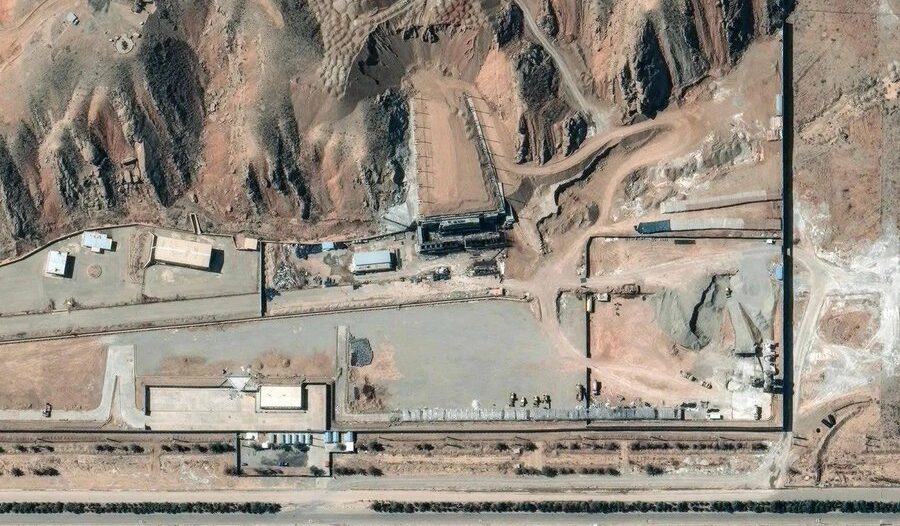
New satellite imagery shows major construction operation underway at Taleghan 2, a facility inside Iran’s sprawling Parchin military complex southeast of Tehran. The imagery, produced by Vantor Technologies and analyzed by the Institute for Science and International Security (ISIS), reportedly shows large tarp covering the site while construction crews work underneath and around it. Dump trucks, bulldozers, cranes, concrete mixers and concrete pumps are visible, alongside continuing work to reinforce and protect the damaged installation.
Israel destroys the facility. Iran rebuilds it. Israel strikes again. Iran begins rebuilding again. And each reconstruction appears to have made the installation more heavily protected. Taleghan 2 is not an ordinary military facility. The site has a documented history tied to Iran’s AMAD Plan, the structured nuclear-weapons effort that Western intelligence agencies say Iran largely halted around 2003–2004.

During that period, Taleghan 2 reportedly housed specialized cylindrical chamber designed for high-explosive experiments. The facility was equipped with flash X-ray systems, allowing researchers to capture images of explosive detonations and study how shock waves behaved inside experimental devices.
That capability is particularly significant because an implosion-type nuclear weapon requires a highly synchronized explosive system capable of compressing a fissile core. Iran reportedly conducted related experiments at Taleghan 2 around 2003. A neighboring installation, Taleghan 1, reportedly contained an even larger containment vessel used for related work. The technology itself is not exclusively nuclear. High-explosive testing can support advanced conventional weapons as well.
But the historical connection to AMAD is what makes Taleghan 2 unusually sensitive. Before the facility was destroyed in 2024, analysts also identified indications that it may have contained equipment associated with the production of high-purity PETN, or pentaerythritol tetranitrate.
PETN is a powerful high explosive that can be processed for specialized military applications. During Iran’s AMAD-era work, PETN was reportedly associated with components of multipoint initiation systems. One such system was reportedly described by Iran as a “shock wave generator.”

The purpose of a multipoint initiation system is to produce a precisely timed detonation across multiple points of an explosive assembly. In a nuclear-weapons context, such synchronization is critical to generating the symmetrical compression required by an implosion design. But again, the technology has dual-use potential.
PETN and sophisticated explosive systems can also have conventional military applications. That distinction is crucial: satellite imagery and open-source reporting do not, by themselves, prove that nuclear weapons are currently being developed at Taleghan 2.
The first major rupture came in October 2024. Israel struck the original Taleghan 2 building during retaliatory operations following Iranian missile attacks. Satellite imagery showed extensive destruction and a large crater at the facility. The attack did not come against an unknown installation. Taleghan 2 had already attracted international attention because of its historical connection to Iran’s AMAD program.
Iran subsequently carried out cleanup and concealment activity around the damaged area, according to satellite-image analyses. The site’s history was even older than the 2024 strike. Between roughly 2011 and 2015, the original facility had reportedly undergone extensive sanitization. Equipment was removed and the location was altered after the earlier nuclear-related activities.
The facility was never directly inspected by the International Atomic Energy Agency. That missing access remains one of the central problems surrounding the site.
The destruction did not end activity at Taleghan 2. By May 2025, reconstruction was becoming visible. And the replacement was not a simple replica of the building that had been destroyed. By late 2025, satellite imagery showed a substantially larger structure with an arched roof, estimated at roughly 40–45 meters long and 17 meters wide.
Inside was an enormous cylindrical metal object estimated to be about 36 meters long and 12 meters in diameter. Analysts said its dimensions and configuration resembled a large high-explosive containment vessel. The significance was immediate. A structure was being rebuilt at a historically nuclear-linked site, and inside it was an object resembling the kind of large containment system previously associated with high-explosive experimentation.
Smaller structures also appeared around the main building. Analysts suggested they could potentially function as blast traps, access structures or protective portals.
Iran subsequently took the reconstruction a step further. Large quantities of concrete were poured over the facility and its associated structures. Earth was placed over significant portions of the complex. The result was effectively a hardened, buried installation. The protective measures could increase resistance against aerial attack while simultaneously making the interior much more difficult to observe.
In March this year. During broader Israeli operations against Iran, the rebuilt Taleghan 2 complex was struck again. Multiple bunker-penetrating weapons hit the hardened facility and satellite imagery showed several large penetration points in the area surrounding the suspected containment vessel.
Internal and surrounding structures were damaged, while protective features around the installation were destroyed or collapsed.
Israel Defense Forces said the facility was connected to advanced explosives development and sensitive experiments associated with Iran’s former AMAD nuclear-weapons program. For the second time, the facility had been targeted. And for the second time, Iran began rebuilding.
By June and July 2026, repair activity was visible.
Workers were reportedly sealing penetration holes with concrete, installing reinforcement and rebar, constructing additional concrete aprons; and clearing damaged material besides strengthening facility against future attacks. The sequence had become difficult to ignore.
Destroyed in 2024. Rebuilt in 2025. Struck again in 2026. Rebuilt again in 2026. The scale of the investment raises a fundamental question:
The latest imagery provides another piece of the puzzle. It show a tarp covering the installation while heavy machinery operates around it. Among the equipment reportedly visible are dump trucks, bulldozers, cranes, concrete mixers and concrete pumps. Concrete work continues, along with additional protective construction. The tarp is also significant from an intelligence perspective.
It makes it more difficult for commercial satellites to determine exactly what is happening underneath. That leaves analysts watching the site’s external signatures, earth movement, construction equipment, concrete placement, building geometry and protective structures—to infer what Iran may be doing.
The imagery cannot reveal the entire story. You need to know that Parchin is a major Iranian military-industrial complex involved in conventional military production and research. A sophisticated high-explosive facility could support missile warheads, munitions, shaped charges and other conventional weapons.
Iran could also be attempting to recover capabilities lost when the original facility was destroyed. That could include specialized explosive testing and diagnostic capabilities without necessarily indicating that nuclear weapons are being assembled or tested.
The most sensitive possibility is that Iran is rebuilding infrastructure that could support nuclear weaponization. High-explosive experiments, multipoint initiation systems, specialized explosives and flash X-ray diagnostics all have relevance to the development of an implosion-type nuclear weapon. But this remains rumours with no confirmed report on it.