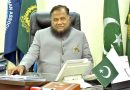
Abdul Qayyum Ch
As dawn breaks over the breathtaking valleys of Kashmir, its natural beauty masks a grim reality.
Beneath the snow-capped mountains, flowing rivers and blooming meadows lies a region imprisoned by Indian occupation. Since August 5, 2019, when India unilaterally revoked Articles 370 and 35-A, stripping Jammu and Kashmir of its special status, the region has been plunged into a suffocating silence. This move stands in stark violation of United Nations Security Council resolutions, bilateral agreements and international law.
The people of Kashmir, already reeling from decades of military oppression, now face even greater restrictions. Their rights, identity and autonomy have been brutally suppressed and their voices drowned out by the echo of tyranny. However, amid this darkness, some voices rise above the rest—voices that refuse to be silenced. One such voice is that of Barrister Sultan Mehmood Chaudhry, a name that resonates not only in the valleys of Kashmir but across international platforms as a symbol of unwavering commitment to justice and self-determination.
I have had the privilege of closely observing Barrister Sultan’s political journey and unshakable dedication to the Kashmir cause. He is not just a politician or The President of Azad Jammu and Kashmir—he is a tireless advocate who has devoted his entire political career to highlighting the plight of Kashmiris before the global community. His efforts go beyond ceremonial statements. He has fearlessly countered India’s propaganda, exposed its state-sponsored terrorism and effectively presented Kashmir’s case on international forums. Among Kashmiri leaders, Barrister Sultan stands out for his vision, courage and clarity. His mission transcends personal ambition or party politics. He has mobilized public opinion globally by organizing five historic Million Marches: in London (2014), New York (2015), Brussels (2016), Dublin (2017) and Berlin (2018). These demonstrations attracted thousands of supporters and drew global attention to Kashmir’s occupation and India’s continued human rights abuses.
Beyond these marches, his impact is visible in the highest forums of international diplomacy. He has addressed the British Parliament, European Parliament, Canadian Parliament and even reached the US Congress, articulating the legal and humanitarian dimensions of the Kashmir dispute. His engagements with global policymakers, rights groups and media have helped keep Kashmir on the agenda, even when the world tried to look away. His diplomatic success has been recognized in Pakistan and abroad. In my own writings—such as “Barrister Sultan’s Political Struggle” and “Kashmir’s Untold Story and Barrister Sultan”—I have chronicled his pivotal role in strengthening Pakistan’s position on Kashmir and rallying support for oppressed Kashmiris.
But Kashmir is not merely a geopolitical issue. It is a living, breathing soul—its rivers sing, its flowers whisper prayers and its landscapes hold centuries of history, poetry and pain. Today, that soul suffers. The once vibrant bazaars are silent, lakes like Dal and Wular reflect fear instead of festivity and schools and mosques echo with absence. It has become a valley under siege, where freedom is a dream deferred. Yet the will of the Kashmiri people has never wavered. Despite decades of brutal occupation, enforced disappearances, communication blackouts and curfews, their spirit remains unbroken. Their hearts beat with the same slogan: “Kashmir Banega Pakistan”—Kashmir will become part of Pakistan.
This bond with Pakistan is not based on sentiment alone. It is rooted in shared history, culture, religion and geography. Kashmir’s rivers flow into Pakistan’s plains; its languages and traditions mirror those of Pakistan. This bond was formalized on July 19, 1947, when the Kashmiri leadership unanimously passed a resolution to accede to Pakistan—nearly a month before Pakistan’s official creation. Pakistan, for its part, has consistently stood by the people of Kashmir. From diplomatic outreach to highlighting Indian atrocities in global forums, it has acted as a moral and political guardian of the Kashmiri cause. India, despite its economic and diplomatic might, has failed to suppress the truth. The world now increasingly recognizes Kashmir as a disputed territory where grave violations of human rights are being committed.
The international community cannot remain silent. Kashmir is not just a bilateral issue—it is a matter of global conscience. The denial of basic freedoms, demographic engineering and the deployment of half a million troops in one of the most militarized zones on earth should alarm every human rights organization, every democracy, every international institution. Barrister Sultan Mehmood Chaudhry embodies the resistance and resilience of his people. His voice carries the cries of mothers who’ve lost sons, the silence of shuttered schools, and the longing of a people yearning to breathe free. Through his advocacy, the world is reminded that Kashmir’s fight is not over—it is alive, just and unstoppable. As the sun rises again over the valley, the hope remains that justice will prevail. The Kashmiri people will not be silenced forever. The day is not far when their sacrifices will bear fruit and freedom will echo through every corner of Kashmir. Insha’Allah.
—The writer is an eminent Senior Analyst providing deep analytical perspectives on key regional and global diplomatic affairs based in Azad Jammu and Kashmir.