
WHAT is history? It is what passed yesterday and changed us.
How did that change occur? History may not be personally concerned with us, yet it does tell us why what happened, how it happened and who did it. In other words, history is a register of deeds that it keeps compiling without regard for anyone. Perhaps fate has taken a similar task from my elder brother, Nawaz Raza. His book “Mard-e-Ahan: Muhammad Nawaz Sharif” seems to encompass the personality of Mian Muhammad Nawaz Sharif, the three-time Prime Minister of Pakistan and a leader of the democratic struggle. This book achieves that and in addition it performs another service.
The period from 2014 to the present will be remembered in our national history for a particular reason. That reason concerns the stability of Pakistan and its democracy. No matter how bitter the relations between Pakistan Muslim League-N and Pakistan People’s Party have been, no one can deny the credit that these two parties, by signing the Charter of Democracy, elevated national unity and democracy above partisan politics. From the Charter of Democracy up until 2014, the relations between the two parties experienced many ups and downs — much has been said about those — yet they did not allow the sanctity of their pact to be compromised. But after the sun rose on 2014, history changed.
In that era something happened that allowed politics to dominate the state and democracy. This ‘feat’ is legitimately attributed to Imran Khan. How Imran Khan accomplished this great feat and who assisted him in this great service are matters of yesterday; but there is a tragedy in the events that passed — an old saying captures it: the eye is blind, the mountain is unseen — yet it is not appropriate to consign history’s debts to oblivion. It is necessary to remember those events. One way to remember them is to access the contemporary news sources of that era — to listen to old radio and television broadcasts or sit in a damp basement leafing through thousands of newspapers. Future historians will still have to do that work, but Nawaz Raza has made much of it easier.
Perhaps it was ordained that the nature of his work should change at just that time. There was a time when his days and nights were ordinary — spent making news and shaping its presentation — but in this period both politics and journalism were put to the test. Thus Haji Sahib had to bid farewell to his established livelihood. What can a lifelong journalist do in such a trial? Haji Sahib began to record the chronicle of this era in a different mode. During this time he preserved the turmoil of our age in weekly columns. In Nawaz Raza’s view, if anyone faced the greatest trial in this hostile era, it was Nawaz Sharif. How was Nawaz Sharif treated during this trial and how did he respond? What were the rulers’ intentions and why did they fail despite possessing every form of power and resource? When faced with failure, what course of action did they take and as they left, how did they treat the country? These are painful episodes of our history; if those interested in history can access them together, nothing could be more important. Nawaz Raza has done precisely that in his book. When the Muslim League-N suffered misfortune, even within the party a form of rebellion surfaced. That rebellion was led by Chaudhry Nisar — the same Chaudhry Nisar who was once Nawaz Sharif’s right-hand man and companion in bad times. Why did Chaudhry Nisar do all this? What were his aims and motives? Sometimes a rebellion born inside a household can besiege a person and make even the greatest falter. What was Nawaz Sharif’s mindset in that difficult phase and what did he think of his former companion at that time? Nawaz Raza’s book also supplies the details of this chapter of history. Not only for the Muslim League-N but for national politics, as a whole, an important question is: who will be Mian Nawaz Sharif’s political successor? This question carries more weight than the future of Nawaz Sharif or the party itself. The reason is that Mian Nawaz Sharif led Pakistan with great courage and energy at a time when efforts were being made to turn Pakistan into a ‘democracy’ like Iraq or Libya. It is true that Nawaz Sharif was deprived of power during that era, but by his political wisdom he prevented the country from falling into the pit of a worst kind of dictatorship. At this stage the question arises whether Nawaz Sharif’s successor will preserve his political tradition or not. It is true that Nawaz Raza does not directly answer this question, but when he refers to Maryam Nawaz as Mian Sahib’s successor, the answers to those questions become apparent by themselves. Against this background, Haji Nawaz Raza’s book holds lasting importance. Anyone who needs to understand this era of Pakistan will find studying this book indispensable.
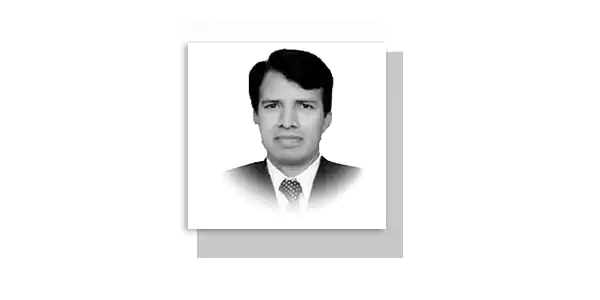
—This writer is former advisor to the President of Pakistan, author & mass media theorist.
(farooq.adilbhuta@gmail,com)