Urban Bystander
In the valley of Margallas, where concrete grows faster than pine, another inauguration concludes.
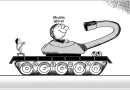
Ribbons cut, cameras departed, speeches about progress dissolved into evening traffic. His Dualness is there, sweating under the conviction that asphalt is destiny, still nodding at phantom applause. This morning he held a meeting with himself. Both sides agreed: more concrete. At his side drifts Barkat Contractor, patron saint of profit-per-pour, polishing the plaque that will outlast the road. “Quality work,” he murmurs, already sketching the repair tender. “Guaranteed for six months, or the next monsoon, whichever comes first.” They are here to sanctify another corridor: the Rs 1.49 billion T-Chowk Flyover, one of six new projects worth Rs 23 billion.
From above, Babloo reports 1.2 million vehicles looping the capital daily, up from 0.35 million in 2000, at an average speed of 26 kilometers per hour, the pace of a determined pedestrian. Each month, 3,000 more cars join the congregation. Every removed signal invites a fresh bottleneck. Average peak travel times have doubled since 2005, but meeting minutes insist the delays are ‘transitional.”
Below, the pattern is clear: a monocentric city strangled by its own geometry. Every ministry in one corner. Every ministry worker somewhere else. The federal government flows in at 9 AM and ebbs at 5 PM, drowning every corridor twice daily. Singapore built polycentric hubs. Beijing moved its government out. Malaysia built Putrajaya to relieve Kuala Lumpur. Islamabad? Six more underpasses to the same destination.
At twilight, Babloo and Nosy Mynah turn accountants of loss. Satellite data doesn’t lie: 10% of green cover gone since 1990. The massacre peaked when 25,000 trees in F-9 Park were razed overnight for a corridor. ‘They called it beautification,’ Babloo croaks. ‘I called it genocide with a ribbon-cutting ceremony.’ Nosy Mynah tilts her head. “At least the trees got a press release”.
From his G-6 balcony, Professor Arif Qureshi watches the slow funeral of motion. He once taught that order was a civic virtue. Then one morning at H-8 underpass, a wrong-side motorcyclist he signaled delivered a lecture on whose city this really was. Since then, he dresses every morning, walks to his old Mehran, and sits behind the wheel without turning the key. He has forgotten how to drive, perhaps forgiven the city for moving on without him. His wife brings him tea in the car now. She doesn’t ask anymore.
In a G-9 basement lives the cartographer of delay, who maps the city not as planned, but as it moves: loops upon loops, connectivity without consequence. On certain afternoons, he joins the Professor in the parked Mehran. “Roads multiply without purpose”, the cartographer murmurs. “35% more in twenty-five years”. The horizon remains stationary.
Elsewhere, at dusk, Barkat inspects his dominion through a hovering drone. The screen shows progress embalmed in red brake-lights. He smiles. “When do we start the underpass?” he murmurs to himself. “All of them. Simultaneously.”
Through the drone feed, three shadows flicker, voices from cities that learned.
Singapore sighed “We priced congestion and built buses. You subsidise it and call it development”. Curitiba murmured “We gave each citizen 52 square meters of green. You gave them a bypass through a park”. London exclaims “We made drivers pay for gridlock. You make them pay for sitting still”.
Barkat waves at the screen. “International context is a Western conspiracy.”
Babloo circles above, seeking the vanished canopy. The junction has traded shade for signage, trees for traffic cones, breath for asphalt.
The city goes home. Another day, another flyover. Another inauguration, another jam. The roads multiply. The trees don’t.
Babloo circles above, filing his report.
“Plan, build, gridlock.”
(The writer can be reached at [email protected])