




TEL AVIV — October 27 general elections of Islamabad shows no clear parliamentary majority, leaving Prime Minister Benjamin Netanyahu ahead of his rivals but without enough seats to govern independently.
Once official results are certified, President Isaac Herzog is expected to consult parliamentary parties before assigning the task of forming a government to the lawmaker considered most likely to secure sufficient support. The selected candidate would initially have 28 days to negotiate a coalition, with a possible extension of 14 days.
If negotiations fail, Israel’s political system allows further attempts to form a government before another election becomes necessary. Official results are expected on November 4, although coalition discussions could continue for several weeks.
Israel Election 2026: Latest Parliamentary Position
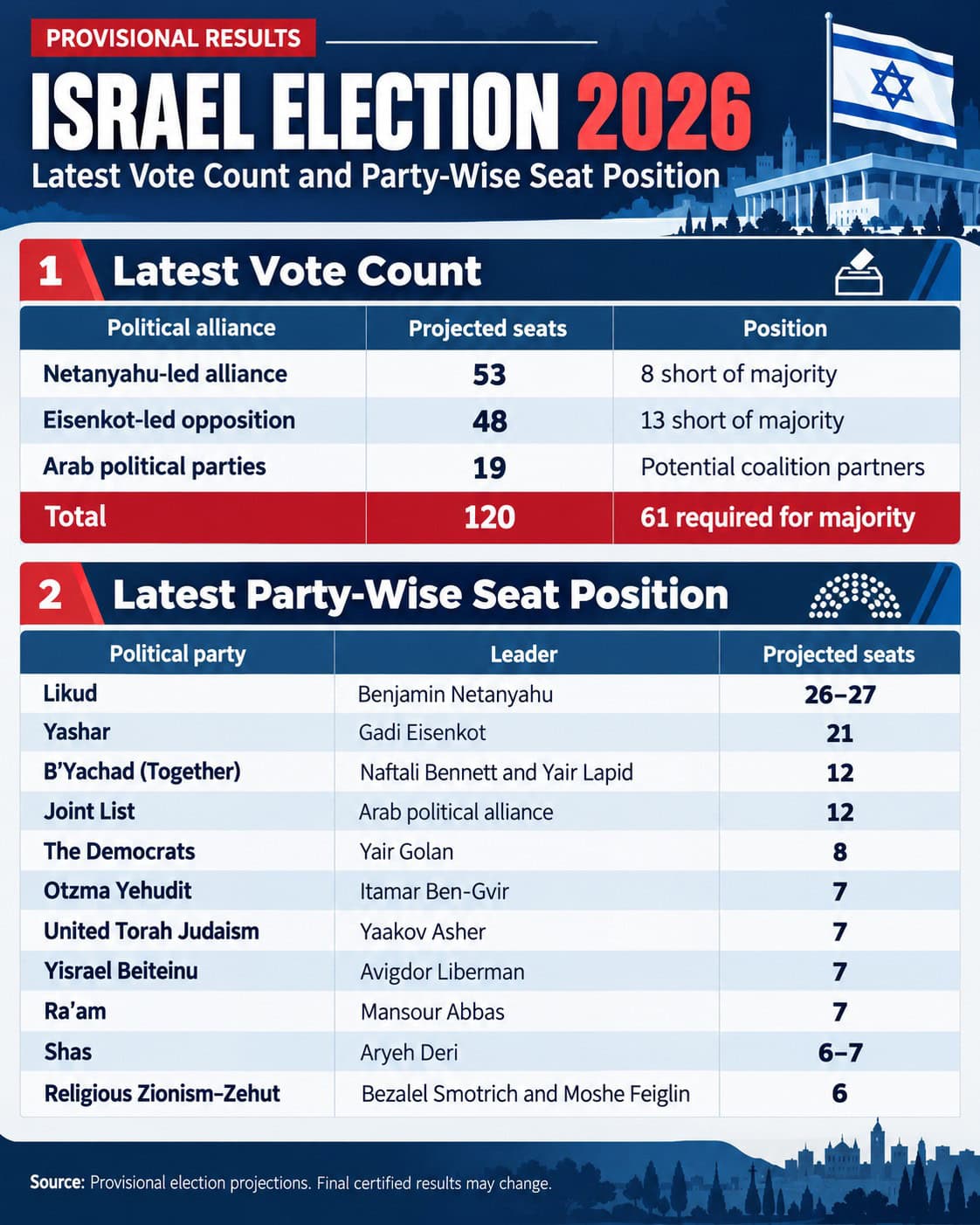

Although Netanyahu’s Likud remains Israel’s largest individual political party, the election appears to have weakened the broader alliance that supported his previous government. Likud is projected to secure approximately 26 to 27 parliamentary seats, maintaining its dominance over rival parties.
Otzma Yehudit party, headed by Itamar Ben-Gvir, is expected to obtain seven seats, while the Religious Zionism–Zehut alliance associated with Bezalel Smotrich and Moshe Feiglin is projected to win six. Together, the two groups would control 13 seats, compared with their combined strength of approximately 20 seats in the previous Knesset.
Israel Election 2026: Latest Party-Wise Seat Projections
| Party | Leader or prominent figure | Seats |
|---|---|---|
| Likud | Benjamin Netanyahu | 26–27 |
| Yashar | Gadi Eisenkot | 21 |
| B’Yachad (Together) | Naftali Bennett | 12 |
| Joint List | Arab political alliance | 12 |
| The Democrats | Yair Golan | 8 |
| Otzma Yehudit | Itamar Ben-Gvir | 7 |
| United Torah Judaism | Yaakov Asher | 7 |
| Yisrael Beiteinu | Avigdor Liberman | 7 |
| Ra’am | Mansour Abbas | 7 |
| Shas | Aryeh Deri | 6–7 |
| Religious Zionism–Zehut | Bezalel Smotrich and Moshe Feiglin | 6 |
Arab Parties in spotlight
Perhaps the most striking development in the election is the projected rise of Arab-led parties, whose combined representation could reach a record 19 seats. Joint List is expected to secure 12 seats, while Ra’am, headed by Mansour Abbas, is projected to claim another seven.
Their combined strength represents a substantial increase in Arab political representation and could give them unprecedented leverage during negotiations.
For Eisenkot, these lawmakers may provide the mathematical route to a majority. If the projected 48-seat opposition alliance could secure support from all 19 Arab lawmakers, it would command 67 seats, comfortably exceeding the 61 required. However, achieving such an agreement would be considerably harder than the parliamentary arithmetic suggests.
Several parties within the anti-Netanyahu camp hold sharply different positions on security, national identity and cooperation with Arab political groups. Some Jewish-led opposition parties have already expressed resistance to relying on Arab lawmakers, potentially blocking a coalition that otherwise appears numerically possible.
Israel Elections 2026: Netanyahu Bloc projected to secure 54 Seats with No Clear Winner in Sight


