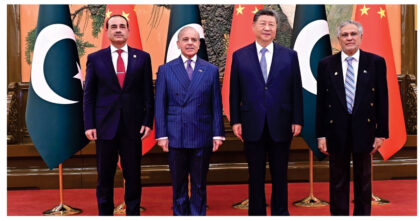
The second phase of the China-Pakistan Economic Corridor (CPEC 2.0) has marked a fresh beginning in the economic cooperation between China and Pakistan and is now focusing more on trade, industrialization, agriculture, mining, innovation, technology and regional connectivity. In this changing context, Xinjiang Uygur Autonomous Region is becoming a more and more vital gateway between China and Pakistan, connecting the two countries via the Karakoram Highway and the Khunjerab-Sost border crossing. Pakistan has already termed Xinjiang as the birthplace of CPEC and has underscored the historical and cultural bond between the two nations and urged to expand trade, connectivity and people-to-people relations by expanding the use of Khunjerab-Sost crossing. This geographical consideration makes Xinjiang play a unique strategic role in the next stage of the CPEC. The region is located at the northwestern part of China and at the crossroads of trade with China to Central Asia and South Asia and the rest of Eurasia.
These ties will help Pakistan open up new opportunities for expanding bilateral trade, logistics and economic activities across the borders with Xinjiang. The transition of the Khunjerab Pass towards 24/7 movement is one of the major achievements for CPEC 2.0. In 2023, China and Pakistan reached an agreement for the Khunjerab Pass to be open for transport all year round and that it would enhance the infrastructure and accessibility. It was also agreed that it will be very important for bilateral trade and people-to-people contacts.
In December 2024, Pakistan and China started year-round operations at Khunjerab Pass, providing an opportunity to develop a more continuous land-based trade corridor between Pakistan and western China. More sophisticated customs procedures, updated inspection facilities, digital documentation and enhanced logistics can contribute to more efficient cross-border trade, particularly for crops and perishables requiring predictable transportation. Xinjiang has also been rapidly expanding its infrastructure. According to China’s State Council Information Office, the region’s railway network reached 9,202 kilometres in 2024, compared with 4,914 kilometres in 2012, while its highway system grew to 230,000 kilometres. The region also had 595 civil aviation routes, including 25 international routes. These developments demonstrate Xinjiang’s growing potential as a logistics platform for CPEC 2.0, supported by an expanding network of ports and logistics facilities. This connectivity can help strengthen trade, investment and economic links between Pakistan and western China.
In 2024, more than 16,400 China-Europe freight trains travelled through Xinjiang. Connectivity is the significance of this infrastructure for Pakistan. More integrated Chinese markets and, via wider links with the rest of Eurasia, other markets could be available to Pakistani enterprises via better connected Chinese logistics hubs. The new CPEC (2.0) is shifting the focus from development through infrastructure cooperation to development through trade and investment. Both Pakistan and China have agreed in the formal agreement to make CPEC 2.0 industry-centric with emphasis on industry, agriculture and mining, alongside enhancing trade and investment, information technology, science and technology, education and skills development. Xinjiang can play an important role in this transition through being a link between Pakistani producers and Chinese markets.
Official figures reveal the rapid growth of the development of Xinjiang’s own foreign trade. The total volume of its imports and exports in 2024 was 434.16 billion yuan, according to China’s State Council Information Office. This will provide an excellent opportunity for Pakistan to expand its exports of its competitive products such as agriculture products, minerals, textiles etc and build relationship with the Chinese companies. The opportunity isn’t just for trading finished goods. There is also a strong focus on industry cooperation in CPEC 2.0. Pakistan and China have agreed to promote investment in Pakistan’s industrial & manufacturing sectors, including via Special Economic Zones, by the Chinese.
The experience Pakistan has in Xinjiang could be more than trade quantity. In June 2025, Pakistan’s Ambassador to China, Khalil Hashmi, visited the Khorgos Free Trade Zone and Dry Port in Xinjiang to explore the technology-based customs and border-management systems. The discussions covered the study of what is being done in Khorgos which could be applied in the Khunjerab border facility. In addition to roads, the future of cross-border trade will rely on digital customs, on integrated border management, on logistics technology and on cold-chain systems and on efficient inspection mechanisms.
The Karakoram route and Khunjerab link Pakistan to western China and the port of Gwadar is a sea port. Gwadar has been identified by both countries as a key node point of regional connectivity and multiple meetings between the two have resulted in multiple commitments to further develop Gwadar and its supporting infrastructure. This gives rise to the larger vision of the connectivity running across Pakistan from the high-altitude border with Xinjiang to the Arabian Sea. CPEC 2.0 can thus be more and more seen as a network of production, markets, logistics and people. Additionally, Xinjiang’s contribution also adds a regional dimension to CPEC 2.0. The fact that it has a proven relationship with Central Asia and the broader Eurasian transportation hub makes it possible for Pakistan-China connectivity to integrate into broader trading routes.
Xinjiang is strategically important for Pakistan, not just because it is a neighboring Chinese region but also because it has the potential to be a conduit to broader Asian markets. There is a need to address practical considerations for the success of this connectivity, such as efficient border management, reliable infrastructure, competitive logistics, promoting export from Pakistan, private-sector participation and continued investment in industrial capacity. CPEC 2.0 is the approach to achieving these goals. The next phase of CPEC has already been identified in Pakistan and China as growth, livelihood, innovation, green development and openness.The importance of Xinjiang for CPEC 2.0 is far more than just geographical. It is an essential player in the next phase of the China-Pakistan connectivity due to its developing transport network, logistics networks and growing international trade, border facilities etc. In the aftermath of the success of CPEC 1.0, CPEC 2.0 can leverage the foundations of connectivity to create a more resilient trade, investment, industry and innovation ecosystem.