
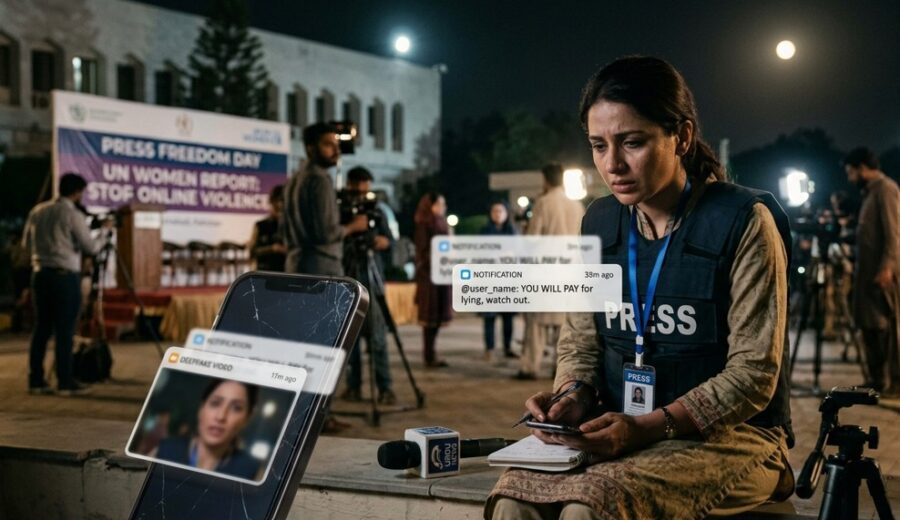

ISLAMABAD – The cases of online violence targeting women journalists have doubled since 2020, severely affecting their mental health, professional performance and freedom of expression, according to a new international study released ahead of World Press Freedom Day, observed on May 3.
The report, published by UN Women along with partner organisations, highlights the growing scale and sophistication of digital harassment against women in public roles, particularly in the age of artificial intelligence (AI). It notes that online abuse has become more invasive, technologically advanced and psychologically damaging than in previous years.
Based on a 2025 global survey covering 641 respondents from 119 countries, the findings show that 12 per cent of women journalists experienced non-consensual sharing of personal images, including intimate content, while 6 per cent reported being targeted through deepfakes or AI-manipulated visuals.
UN Women’s representative Kalliopi Mingerou said AI-driven technologies are amplifying abuse, making it easier to target women and intensifying threats to democratic freedoms and gender equality.
The report, titled “Tipping Point: Online Violence Impacts, Manifestations and Redress in the AI Age,” reveals a sharp rise in self-censorship among women journalists and media workers. In 2020, 30 per cent reported limiting their expression due to online harassment, but by 2025 this figure increased to 45 per cent.
Among women writers and public communicators, 50 per cent said they avoid posting freely on social media, while 26 per cent admitted to restricting their expression in professional environments. Similarly, 45 per cent of journalists reported self-censorship online, and 22 per cent said it affects their workplace communication.
Silencing women journalists online undermines:
🔵 their voices
🔵 their wellbeing
🔵 press freedomAhead of #WorldPressFreedomDay, new EU-funded research by @UN_Women shows how online abuse in the #AI age leads to self-censorship.
🔗 https://t.co/Tp8qxThgCj#ACTtoEndViolence pic.twitter.com/XwzvUf91L9
— UN Women (@UN_Women) April 30, 2026
The situation is also concerning for human rights defenders and activists, with 43 per cent reporting silence on social media and 20 per cent in professional settings due to fear of harassment. Around one-third of respondents also reported receiving unsolicited sexual messages online.
The report further highlights that 12 per cent of women in media and advocacy roles have faced non-consensual sharing of personal images, while 6 per cent have been victims of AI-generated deepfakes. A significant 41 per cent said they now self-censor online to avoid abuse.
While some forms of image-based harassment occur through social media messages and unsolicited explicit content, the study notes a growing trend of AI-driven “nudification” and cyber harassment.
Despite the rising threat, the report shows a slight increase in reporting and legal action. Around 22 per cent of women journalists reported online violence to law enforcement, compared to 11 per cent in 2020, while legal action against perpetrators or platforms rose from 8 per cent to 14 per cent.
The psychological impact is also severe, with nearly 25 per cent of women journalists reporting diagnoses of anxiety or depression, and almost 13 per cent suffering from post-traumatic stress disorder (PTSD).
The study also points to financial and professional consequences, with some respondents reporting job loss, resignation and long-term emotional distress due to sustained online abuse.
Despite the growing crisis, the report warns that legal protections remain weak globally, with fewer than 40 per cent of countries having adequate laws against cyber harassment or cyberstalking.
The findings form part of an ongoing global research series examining online violence against women in public life, with future reports expected to explore perpetrators’ behaviour and the role of major technology companies.
Dr Omer Adil arrested by FIA over defamatory allegations against women


