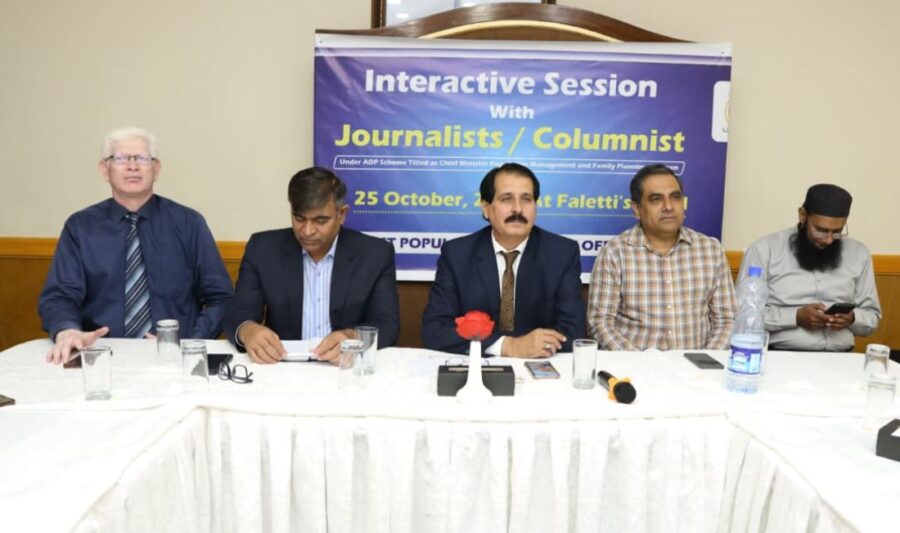

LAHORE – Experts on Saturday called for urgent and practical measures to address Pakistan’s rapidly growing population, warning that unchecked growth, particularly in Punjab, could hinder national development in the coming years.
The session, organised by the Lahore District Population Welfare Office under the ADP Scheme “Chief Minister Population Management and Family Planning Programme,” highlighted the need for youth engagement, public awareness, and a unified national policy on population management.
District Population Officer Mazhar Iqbal cautioned that Pakistan’s population could reach 260 million by 2030 if awareness efforts are not intensified. “Pakistan has a very large youth population—about 64 percent. If these young people are not properly guided and informed, they could become a burden on the state rather than an asset,” he said.
Iqbal stressed that population management policies must be context-specific and free of misconceptions. “Many assume the Population Welfare Department seeks to stop reproduction altogether, which is incorrect. Our goal is balance, not restriction,” he clarified.
Sharing comparative provincial data, Iqbal noted that Punjab remains the most populous province, while Balochistan has the lowest population. He added that population strategies differ accordingly, pointing out that the Population Welfare Department in Balochistan is actually working to increase population levels.
He further announced that the district administration is collaborating with religious scholars and social media influencers to promote family planning awareness, with the campaign set to continue until 2027.
Deputy Senior Manager Amir, representing the Marie Stopes Society, highlighted the life-saving potential of family planning, citing alarming maternal and newborn health statistics. “A mother dies every 50 minutes due to complications from unintended pregnancies. Forty percent of all births in Pakistan are unintended, and this is a major health crisis,” he said.
Amir also drew attention to the lack of access to contraceptives, noting, “It is unfortunate that Coca-Cola is available everywhere, but contraceptives are not—even in major cities like Lahore. Contraceptive use could prevent 72 percent of maternal deaths and 78 percent of newborn deaths.”
Two female doctors at the session stressed the importance of culturally sensitive communication. “There is no simple or familiar word for ‘contraceptive’ in Urdu, Punjabi, or other local languages, which makes it difficult to communicate the message effectively,” one doctor observed.
The event concluded with a discussion among journalists and columnists, who shared strategies to enhance awareness campaigns using relatable language and broader media engagement.