Bahria Town, once the face of Pakistan’s real estate, remained in dire straits in recent years amid massive probe and cases against its fugitive founder. For families who have spent years building their lives inside Bahria Town, the current uncertainty is becoming deeply personal.
A dispute that once appeared to be largely about the developer, government agencies and courts is now reaching the front doors of ordinary homeowners. Some residents have received notices from the Capital Development Authority (CDA) questioning the legality of the land on which their houses stand. Others are watching property prices fall, transfers become more difficult and buyers grow increasingly hesitant.
The anxiety intensified for residents of Bahria Town Phases 1–6 in Islamabad after CDA notices were issued concerning properties allegedly constructed on land designated as open space. The notice is particularly stark, saying the building was constructed on land earmarked as an open space in the approved layout plan for Bahria Town Phases II, III, V and VI in Zone-5, Islamabad. The layout plan was approved on August 30, 2000.
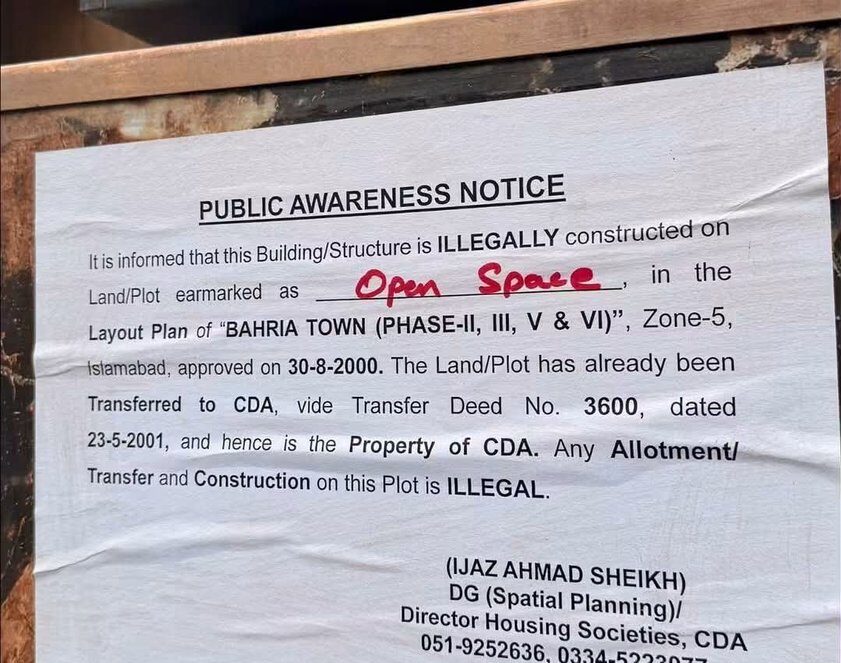
The notice goes further, saying the land had already been transferred to the CDA through Transfer Deed No. 3600, dated May 23, 2001, and therefore belonged to the authority. On that basis, the notice challenges any subsequent allotment, transfer or construction on the plot. For a resident who has lived in the house for years, the implications are difficult to digest.
The obvious questions are immediate: If I bought this house, got possession and have been living here for years, what happens now? What happens to my investment? Can I sell the property? And who ultimately stands behind the documents I was given? Those questions are becoming increasingly difficult to ignore.
CDA notices come against the backdrop of a much wider legal and financial crisis surrounding Bahria Town and its founder, Malik Riaz Hussain.
The consequences are being felt across several Bahria Town developments, particularly in Karachi and Rawalpindi, and Islamabad.
Meanwhile, Pakistan’s National Accountability Bureau (NAB) has moved against assets linked to Bahria Town and members of Riaz’s family. In June 2025, the anti-graft watchdog issued freezing orders covering properties associated with Riaz’s son and Bahria Town as part of its proceedings.
Then came another significant development: NAB said it had frozen around $4.5 million in foreign bank accounts allegedly belonging to Malik Riaz and his wife. The allegations include money laundering and the alleged use of state land for private housing developments—claims that remain contested in the relevant legal proceedings.