


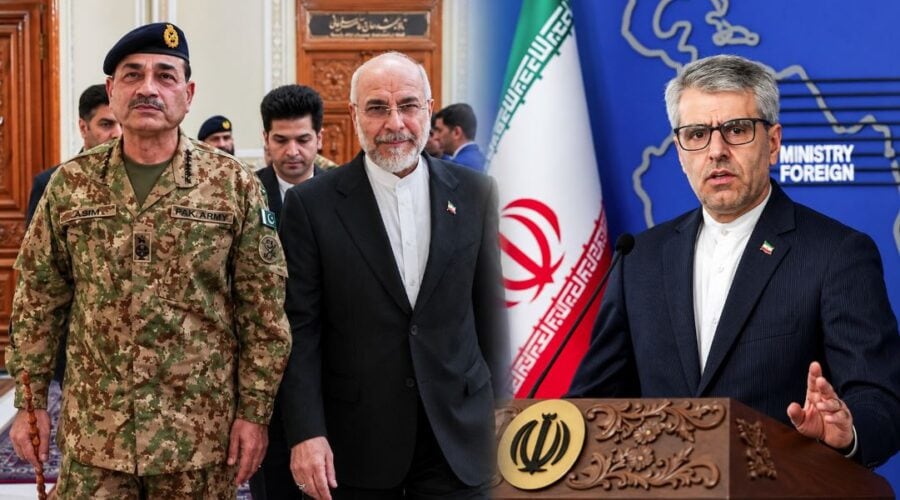

TEHRAN – Field Marshal Asim Munir proposed first joint meeting between Iran and senior representatives of Pakistan, Saudi Arabia and Türkiye during his recent visit to Tehran, Iran’s Foreign Ministry has said, placing Pakistani top general at the centre of a fresh regional diplomatic initiative.
Iran Foreign Ministry spokesperson Esmaeil Baghaei disclosed proposal at his weekly press briefing on Monday, as Tehran prepared to host high-level consultations on regional security and recent military tensions between Iran and the United States. Baghaei said the gathering would be the first of its kind, with Iranian President Masoud Pezeshkian and Supreme National Security Council Secretary Mohsen Rezaei also participating.
Earlier, the council’s deputy secretary, Ali Bagheri, announced that Saudi Defence Minister Prince Khalid bin Salman, Pakistan’s armed forces chief Field Marshal Asim Munir and Turkish intelligence chief Ibrahim Kalin would attend the joint meeting with Iranian officials in Tehran.
The gathering brings together senior defence, military and intelligence figures for discussions covering the regional situation, shared security concerns and opportunities for cooperation. According to Baghaei, recent military tensions between Tehran and Washington will feature on the agenda, giving the consultations added significance amid concerns over further instability.
The meeting offers direct channel for the four countries to discuss their security priorities. Its outcome will depend on whether those consultations produce common ground and concrete steps toward easing tensions.
Field Marshal Syed Asim Munir is representing Pakistan alongside Saudi Defence Minister Prince Khalid bin Salman and Turkish intelligence chief Ibrahim Kalin. The October 26 initiative includes meetings with Iranian President Masoud Pezeshkian and Supreme National Security Council Secretary Mohsen Rezaei. The discussions centre on regional security, tensions between Iran and the United States, and the worsening situation in Palestine and Lebanon. Participants are seeking common ground on de-escalation, stronger cooperation and a diplomatic path through the crisis.
Pakistan’s military media wing confirmed Munir’s official visit to Tehran. Iranian Foreign Ministry spokesperson Esmaeil Baghaei said the proposal for the joint meeting was put forward during the Pakistani military chief’s recent visit to Iran and was subsequently welcomed by Tehran.
Baghaei described the gathering as the first of its kind, bringing representatives of the Makkah Joint Defence Agreement countries—Pakistan, Saudi Arabia and Türkiye—into joint consultations with Iran’s senior leadership.
Field Marshal Asim Munir visits Tehran ahead of Makkah pact officials’ talks with Iran
He said the agenda would cover developments in Palestine and Lebanon, regional security concerns and the consequences of US and Israeli military action against Iran.
Saudi Deputy Minister for Public Diplomacy Dr Rayed Krimly said Prince Khalid was leading the Saudi delegation as part of continuing efforts to reduce tensions, encourage negotiations and support a diplomatic settlement. He said the initiative reinforced mediation efforts being undertaken by Pakistan and Qatar, placing the Tehran consultations within a broader attempt to keep communication channels open between the parties involved.
Reports also indicated that a Qatari mediation delegation had arrived in Tehran to convey messages and demands from US President Donald Trump. Details of those exchanges, including reported discussions over Iran’s frozen assets, have not been publicly confirmed.
Iran has separately linked the reopening of the Strait of Hormuz to the lifting of the US naval blockade of its ports. Tehran’s ambassador to Pakistan, Reza Amiri Moghadam, said that position had been conveyed through Pakistani intermediaries.
The maritime dispute remains a central issue, with any progress potentially creating space for wider negotiations. Tehran has maintained that it remains open to diplomacy while reserving its right to defend itself.
The presence of senior Pakistani, Saudi and Turkish officials in Tehran gives the initiative considerable diplomatic weight. It brings countries with distinct security interests to the same table as they seek to prevent further escalation. The restoration of Saudi-Iranian relations has provided an opening for engagement, while Pakistan’s contacts with Tehran and its mediation efforts have placed Islamabad in a prominent position.


