
ISLAMABAD – Pakistan International Airlines handed its top job to seasoned aviation expert as its new private owners pursue ambitious recovery plan involving billions of rupees in investment amid major fleet expansion and target of profitability within their first year.
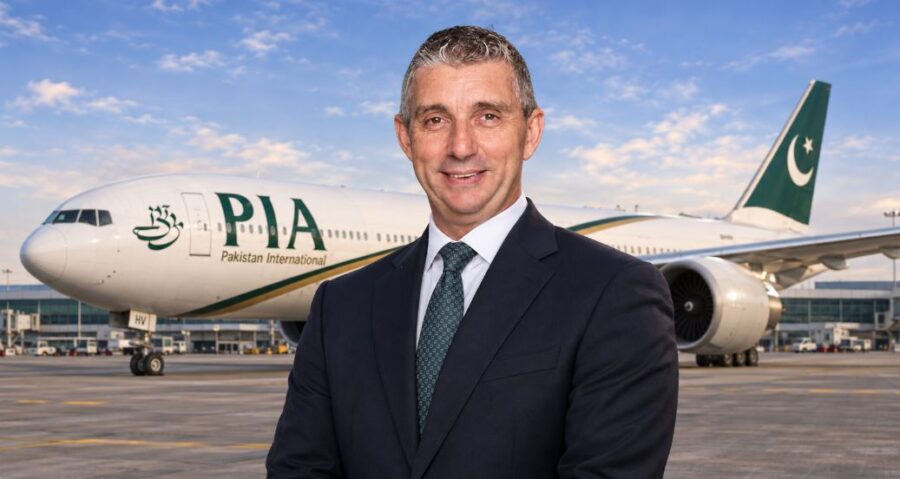
PIA board announced Adrian Hamilton-Manns as chief executive today as he took charge. New Zealand-born executive is now facing serious assignment, rebuilding full-service national carrier after years of financial strain, operational difficulties and political interference. His appointment brings extensive experience in low-cost airlines to PIA’s effort to restore its commercial standing.
With around three decades in aviation and three airline chief executive roles behind him, Hamilton-Manns has been described by PIA as a world expert in airline transformation and revival. The board expects his leadership to accelerate restructuring, raise service standards and help deliver sustainable profitability.
He most recently headed Oman’s Muscat-based budget carrier SalamAir, serving as CEO from July 2024 until 2026. Before that, he led FlyArystan, the low-cost subsidiary of Kazakhstan’s Air Astana Group, as president and chief executive from April 2020 to July 2024.

Hamilton earlier leadership experience includes serving as founding CEO of Africa-focused budget venture flyafrica.com, approximately between 2012 and 2016. He also held senior commercial positions at IndiGo, South African Airways, Virgin Australia’s Pacific Blue and Indonesia’s Mandala Airlines, which has been associated with Tiger Airways. His aviation career began at Air New Zealand in 1997.
His professional record centres on airline restructuring, commercial management, network growth and digital and self-service operations. Reports credit his FlyArystan tenure with substantial revenue growth and recognition through Skytrax ratings. However, most of his senior assignments have involved low-cost operators. At PIA, he will be applying that experience to a full-service airline with domestic, regional and long-haul responsibilities.
Reports of his nomination first appeared in mid-October, when the appointment remained subject to clearances. Published accounts differ slightly on the dates of some previous roles and the precise length of his experience.
Hamilton-Manns replaces Air Vice Marshal (retd) Aamir Hayat, also identified as Amir Hayat in some reports, who led PIA for roughly four to four-and-a-half years. The board paid tribute to Hayat’s role in structural reforms, operational improvements and preparations for privatisation. It also acknowledged efforts to strengthen internal safety standards during a period of considerable pressure on the airline.
Those improvements helped enable the lifting of European flight restrictions in late 2024 and British restrictions later in 2025, restoring access to markets that are central to PIA’s recovery ambitions. The leadership transition comes as the airline moves deeper into private ownership following one of Pakistan’s largest privatisation deals in decades, described in reports as its first major such transaction in nearly 20 years.

An Arif Habib Corporation-led consortium won the auction for an initial 75% stake with a bid of approximately Rs135 billion around December 23, 2025. Rival bidders included groups linked to Lucky Cement and Airblue. The purchasing group, operating through a special-purpose vehicle identified in reports as PIA Equity Ltd, includes interests associated with Arif Habib Group, Fatima Fertilizer, Fauji Fertilizer, Lake City Holdings, The City School and AKD Group, among others.
Share Purchase and Subscription Agreement followed in early 2026. The first financial closing on June 29 transferred management control to the consortium, while the transaction also included arrangements for the remaining 25% government holding. Estimates place overall financial commitment at around Rs180 billion, including approximately Rs55 billion in government receipts and Rs125 billion in fresh equity intended to rebuild and expand the airline.
The investment structure directs most of the initial funds into PIA itself. Reports commonly cite a 92.5% reinvestment share for the initial proceeds, with payments to the government spread across stages, including initial receipts exceeding Rs10 billion.
A second closing was reportedly envisaged within approximately 12 months, alongside further equity of around Rs45 billion. A call option for the government’s remaining 25% stake has separately been valued at approximately Rs45 billion. These amounts concern different stages and components of the transaction and do not represent separate sums that can simply be added to the headline commitment.
To prepare PIA for sale, the government absorbed legacy liabilities running into hundreds of billions of rupees. Employees were given job protection for at least the first year, while pension arrangements were handled separately. Certain non-core assets, including properties such as the Roosevelt Hotel, remained outside the core aviation transaction under the reported restructuring arrangements.
For the new owners, the immediate commercial ambition is clear: make the airline profitable within the first year of private management. Arif Habib has argued that the core aviation business can become viable through stronger management, commercially justified routes and sharper operational discipline. The wider objective is to reduce the airline’s dependence on taxpayers and address longstanding problems involving inefficiency, an ageing fleet and staffing pressures.
PIA’s overall inventory has been estimated at around 30 aircraft, with several grounded for maintenance or repairs. The proposed expansion combines bringing grounded planes back into service with additional aircraft acquired through leases or purchases.
Fresh investment is intended to support growth without recurring government subsidies, while professional private-sector management is expected to allow faster decisions and reduce political interference. Potential technical partnerships also form part of the broader effort to improve regional and international competitiveness.
PIA Receives First Boeing 787-9 Dreamliner in Major Fleet Upgrade