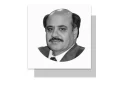
KARACHI – An era of romantic melodies comes to an end as Pakistan bids farewell to another musical legend. The voice that once made millions fall in love with Dil Mein Tum has left this world after long battle with cancer.
Best remembered for his evergreen romantic hit Dil Mein Tum, Bunny was among the musicians who helped give Pakistani pop music a distinct identity during pre-internet times. His deep baritone voice, memorable compositions and unconventional musical arrangements earned him a special place among listeners.
The news of his death has saddened fans and people associated with the entertainment industry, particularly those who grew up listening to his songs during the era of NTM, STN and Music Channel Charts.

His close friend Dr Shafqat Ali said Bunny was taken to Jinnah Hospital after his death, where doctors declared him dead on arrival. Veteran actor Khaled Anam also announced the news on social media, remembering the singer as a dear friend and a wonderful musician who passed away peacefully at home.

His body was subsequently shifted to the Chhipa morgue in Karachi’s FTC area. Bunny’s son, Chengiz, who resides in London, was informed about his father’s death. The family was awaiting confirmation of his arrival before finalising funeral arrangements.

The singer had reportedly expressed his wish to be laid to rest beside his father at Gizri Phase IV cemetery in Karachi. He was understood to have been living a relatively isolated life in his later years, with no family members reportedly present at the time of his death.
Long Battle With Cancer
Behind Bunny’s musical success was a long personal struggle that remained largely away from the public spotlight. The singer had reportedly been diagnosed with tongue cancer nearly 30 years ago. Despite dealing with the illness for decades, he continued to maintain contact with friends and remained connected to music through occasional projects and online releases.
People who knew him said his illness had not taken away his sharp mind, sense of humour or positive approach to life. In one of the final conversations before his death, Tanveer Afridi, associated with Naghma Saaz, reportedly spoke to Bunny just two days earlier and found him seemingly in good health.
Born Mohsin Raza Khan, Bunny’s stage name had an unusual beginning. His father reportedly gave him the childhood nickname because his prominent front teeth reminded him of the cartoon character Bugs Bunny. What started as a family nickname eventually became the identity through which thousands of music lovers recognised him.

His musical journey began around 1973 when he joined a band in Lahore. He gradually developed his performance skills by playing at hotels and musical venues before taking his talent abroad. His journey included performances and stays in countries such as Germany, Italy and the United Kingdom, where he gained exposure to international music and audiences.
For many Pakistani music lovers, Bunny’s identity will forever remain connected with Dil Mein Tum. The romantic number became his signature song and established him as one of the recognisable voices of the country’s emerging pop music scene.

Interestingly, Bunny composed the music himself, while the lyrics were penned by Master Manzoor, also known as Manzoor Akhtar. The song’s musical arrangement had already been developed by Bunny before he approached the lyricist. He subsequently travelled to Lahore to have words written for the composition.
It was recorded at Shadab Studio in Karachi, with keyboardist and arranger Azhar Hussain contributing to its production. At a time when Pakistan’s pop music industry was still developing its modern sound, the composition stood out for its contemporary arrangement. Despite initial reservations about its unconventional style, the song was eventually released and went on to become a major success.
Its popularity received another boost when it featured on PTV’s Music Channel Charts, helping it reach an even wider audience. More than two decades later, the song found another generation of listeners when Roxen, featuring Mustafa Zahid, revived it in a rock version around 2011.
The original music video also had an amusing story behind its production. An initial shoot at the Taj Mahal Hotel, now known as Regent Plaza, failed to satisfy the production team, leading to another shoot at a beach.
Although Dil Mein Tum remained his biggest calling card, Bunny’s musical catalogue included several other popular tracks. Songs such as Deewane, Deewana, Bhangra Is King, Zakhmi Jigar, Pehla Pyar, Raasta Naya, Aa Bhi Ja and Nasheeli helped establish his reputation as a singer and composer. He was particularly recognised for composing much of his own music rather than relying entirely on outside composers.
His later album Raasta Naya also reflected his interest in international music. Its title track reportedly drew inspiration from Sting’s Fragile, with lyrics written by Emad Rehman. Even after stepping away from mainstream television and music appearances, Bunny continued sharing his work through his official YouTube channel, Bunny-Official-Pakistan.
He uploaded restored versions of older recordings, album tracks and updated arrangements while also collaborating with musicians, including Jawad Haider.
Bunny’s contribution to Pakistan’s music industry was not limited to the songs he recorded. He also helped aspiring musicians at a time when access to professional recording facilities was difficult for newcomers. His recording studio in Karachi’s Tariq Road area, associated with Hill Studio and Hill Music Company, became a place where young artists could experiment, record music and develop their abilities.
Rather than treating the studio purely as a commercial business, Bunny reportedly allowed several emerging musicians to use its facilities without charging them. Early members associated with Mizmaar, along with musicians such as Imran Momina and Shallum Xavier, were among those who benefited from his support and guidance.
He shared his experience, offered technical assistance and encouraged young musicians who were trying to establish themselves in the industry. For many, his generosity became as memorable as his musical achievements.
Bunny also had a humorous side, and some of the stories associated with him shows his rare personality. In one incident, a female fan managed to obtain his telephone number and contacted him. During their conversation, Bunny reportedly mentioned how difficult it was to live alone and manage everyday household responsibilities.
The following day, someone arrived to help him with domestic chores. However, Bunny eventually discovered that the supposed helper was actually the same fan, who had arranged the encounter herself. She reportedly revealed her identity after borrowing an English novel by Harold Robbins that was lying on his table. Such stories shows lighter side of a musician who, despite his fame, maintained an individualistic lifestyle.
Bunny gradually disappeared from the mainstream spotlight, but his songs never completely left the memories of Pakistani music lovers. His career coincided with a period when local pop music was developing a new identity, and his romantic compositions became part of the soundtrack of an entire generation.
The death of pop-singer closes a chapter in Pakistan’s pop music history, but the songs he created will continue to connect listeners with an era they remember fondly.