

The federal government on Friday unveiled a new fixed-tax framework for small businesses, as part of broader efforts to widen the tax base and bring more informal businesses into the documented economy.
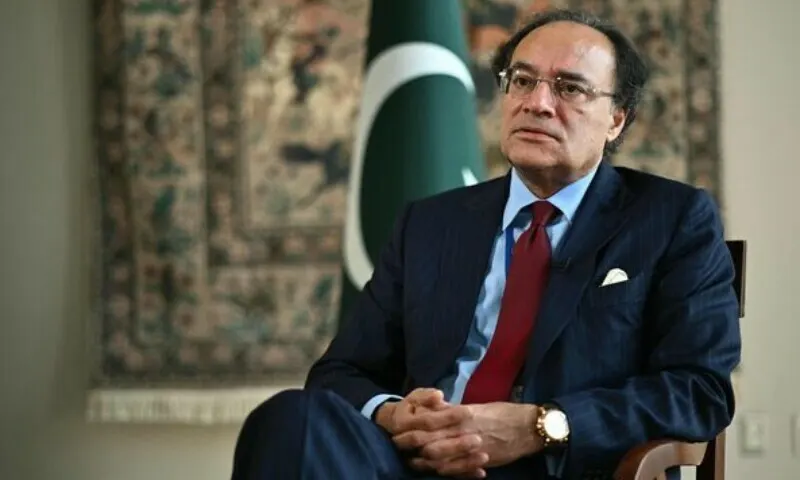
The announcement was made by Finance Minister Muhammad Aurangzeb at a joint press briefing alongside State Minister for Finance Bilal Azhar Kiani, where officials detailed the structure and purpose of the initiative.
Aurangzeb said the government’s priority was to maintain economic stability while steadily improving revenue collection. He noted that there is a general view that tax rates should not be increased at this stage and, in some cases, should even be reduced.
He estimated that around three to four million small traders fall within the category targeted under the new scheme, adding that many previously outside the tax system were now voluntarily coming forward. He said the policy had been developed after consultations with stakeholders, particularly small traders, who had expressed the need for a simpler taxation mechanism.
Bilal Kiani explained that the scheme would apply to retailers with annual sales of up to Rs200 million and is designed to simplify tax compliance through a streamlined process. He said the government was introducing a one-page declaration form to reduce procedural complexity and ease registration for small businesses.
Kiani said the new regime sets a fixed tax rate of 1%, with any already deducted withholding tax adjustable against the final liability. Eligible traders will submit a simple one-page form, available in Urdu, Pashto, Sindhi and Balochi.
He added that participants must deposit a minimum of Rs25,000 when filing the form, regardless of prior withholding deductions. Businesses with higher turnover will pay tax at the prescribed 1% rate based on their declared sales.
Both tax filers and non-filers will be allowed to opt into the scheme. Participation will be voluntary, giving traders the choice between the fixed-tax structure and the existing general tax system.
Those enrolled would generally not be subject to routine tax audits. In exceptional cases, audits could only proceed after consultation with or notification to a committee representing traders’ associations.
Kiani warned that businesses choosing neither to join the scheme nor file returns under the regular system would face monthly penalties of Rs10,000, increasing to Rs25,000 in the second month and Rs50,000 in the third.
He clarified that street vendors and pushcart owners would remain outside the scope of the scheme.
Under the new arrangement, participating traders must ensure their tax payment is at least equal to what they paid in the previous year. Each registered shopkeeper will also receive an official plate issued by the Federal Board of Revenue displaying the trader’s name and business details as a sign of compliance.
Kiani further said that businesses enrolled in the scheme would be exempt from the Federal Board of Revenue’s point-of-sale (POS) requirement, describing the initiative as a step toward simplifying taxation for small enterprises.
Massive surge in digital payments during Eid-ul-Azha 2026: SBP





