



KARACHI – Leading fashion retailer Khaadi is facing fresh questions over its proposed Rs8.3 billion initial public offering (IPO), as Securities and Exchange Commission of Pakistan (SECP) reportedly sought further explanations regarding the company’s financial statements, brand valuation, international operations and expansion plans ahead of its anticipated listing on the Pakistan Stock Exchange (PSX).
Khaadi Pakistan Limited prepares for one of country’s most closely watched retail-sector stock market debuts, with regulators reportedly examining several financial and corporate arrangements that could influence how prospective investors assess the company’s value.
The reported scrutiny is of a multibillion-rupee intellectual property transaction involving Khaadi’s parent company, substantial property revaluation gains, the financial performance of its expanding retail network and the justification for its proposed share pricing.
Under the proposed offering, Khaadi Pakistan Limited intends to issue 500 million new ordinary shares, representing 20 percent of its enlarged share capital of 2.5 billion shares. Half of the shares, or 250 million, are earmarked for pre-IPO investors, while the remaining 250 million will be offered through the public listing process.
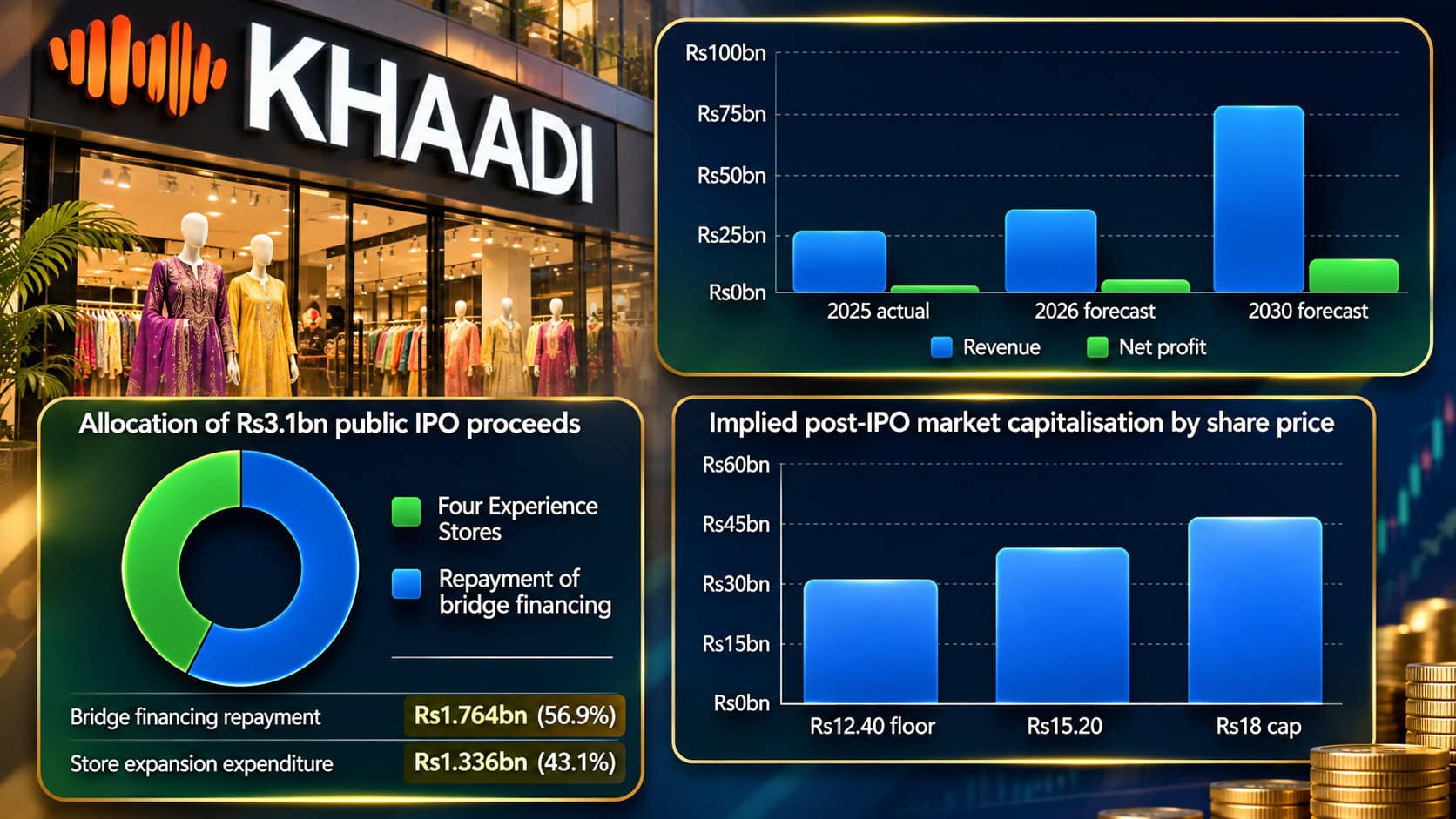
The public offering includes 175 million shares through book-building and 75 million shares reserved for retail investors. The proposed floor price stands at Rs12.40 per share, with a maximum book-building price of Rs18. At these levels, Khaadi’s estimated post-listing market capitalisation would range between Rs31 billion and Rs45 billion.
The company could raise approximately Rs6.2 billion at the floor price and up to around Rs8.3 billion under the proposed pricing arrangements.
Arif Habib Limited is serving as the lead manager and consultant for the transaction. Following the offering, Khaadi’s existing sponsor, Weaves Corporation Limited, would retain an 80 percent controlling stake.
One of key issues reportedly attracting regulatory attention concerns Khaadi’s Rs8 billion acquisition of brand usage rights from its parent company, Weaves Corporation Limited. The transaction, recorded in 2025, gave Khaadi Pakistan exclusive and indefinite rights to use the Khaadi brand domestically.
However, the financial structure raised questions about how the intellectual property was valued, what assumptions supported the Rs8 billion price and whether the commercial arrangements were sufficiently explained to potential shareholders.
The reported regulatory concerns also involve the role of the independent valuer, the relationship between the buying and selling companies, and the terms under which Khaadi must settle the outstanding amount. The transaction is particularly important because it represents a substantial financial obligation to a related party.
Khaadi had Rs7.61 billion in bank borrowings by June 2026. Including the Rs8 billion brand-related payable, its combined obligations reached about Rs15.61 billion, compared with shareholders’ equity of approximately Rs7.48 billion. Although the brand payment obligation is not identical to conventional bank borrowing, its size makes the payment schedule and related-party arrangements crucial considerations for investors.
Another question concerns company’s financial reporting for last year, particularly the recognition of approximately Rs3.32 billion in investment-property revaluation gains. The substantial increase followed change in accounting policy under which investment property was measured at fair value rather than historical cost.
The company also recorded around Rs3.21 billion in fixed-asset write-offs, largely offsetting the accounting gain. Some reports referred to underlying loss of around Rs1.5 billion. However, Khaadi’s disclosed financial statements show a net profit of approximately Rs1.67 billion for 2025, making it important to distinguish reported earnings from adjusted or underlying performance.
The large revaluation nevertheless prompted questions about property valuation methods, supporting assumptions and the treatment of previous financial periods. The company’s 2024 accounts were also restated following the accounting policy change, adding to the need for clear explanations of year-on-year financial performance.
Despite the concerns surrounding certain accounting entries, Khaadi’s disclosed results show improving profitability. The retailer generated approximately Rs25.13 billion in revenue during 2025, compared with Rs24.6 billion in 2024. Its net profit reached Rs1.67 billion, while operating profit stood at approximately Rs3.22 billion.
Performance strengthened further during the first six months of 2026, when revenue reached Rs17.08 billion and net profit climbed to approximately Rs1.61 billion, almost matching the company’s entire annual earnings for 2025. Gross profit margins also improved from around 34 percent in 2024 to 36 percent in 2025 and approximately 37 percent during the first half of 2026.
Khaadi currently operates a substantial retail network across Pakistan and is pursuing an ambitious strategy to replace conventional outlets with larger Experience Stores. The company disclosed 31 stores across 14 Pakistani cities, with 18 outlets converted into the newer format by the first half of 2026.
The broader corporate group also maintains an international presence, including stores and fulfilment operations serving markets such as the United Kingdom, United States and United Arab Emirates.
Regulators reportedly requested further information about international franchise arrangements, investment costs, revenue performance and financial projections for newly opened stores. The company intends to use approximately Rs1.764 billion from public IPO proceeds to repay bridge financing associated with existing stores, while another Rs1.336 billion will support additional Experience Stores in Gujranwala, Sargodha and Islamabad.
Questions have also emerged over the detailed utilisation of proceeds from the separate pre-IPO placement and the safeguards available to minority shareholders.
Khaadi’s valuation is another important consideration. While its proposed IPO price ranges from Rs12.40 to Rs18 per share, a discounted cash-flow assessment estimates fair value at approximately Rs28.16 per share. That assessment depends heavily on projected future earnings, expansion and long-term growth assumptions.
The company’s forecasts forsee revenue climbing to Rs77.57 billion by 2030, with annual net profit reaching around Rs11.47 billion. Such projections show massive growth from current performance and depend on successful expansion, stronger sales and improved margins.
Khaadi gets long-term credit rating of AA- and a short-term rating of A1, both with a stable outlook, reflecting its established market position while also acknowledging financial and liquidity-related risks.
Disclaimer: The developments reported in this article are based on publicly available financial disclosures and media reports. Khaadi Pakistan Limited’s official response to the reported regulatory queries has not yet been confirmed. The company is welcome to share its position, clarification or response, which will be incorporated into this report to ensure fair and balanced coverage.