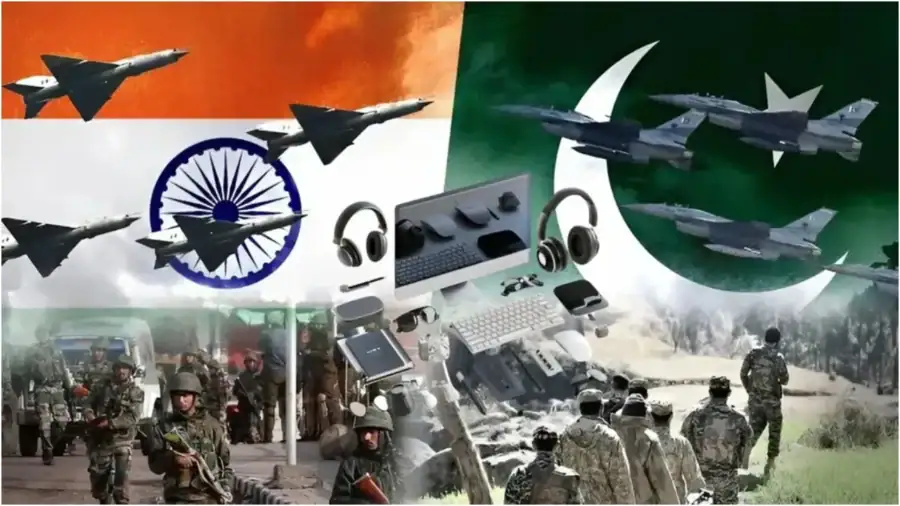

The latest wave of hostility between Pakistan and India has once again pushed South Asia into global headlines, raising fears of escalation between two nuclear-armed rivals with decades of conflict behind them. As political rhetoric intensifies and television studios transform into battlegrounds of nationalism, questions are growing louder across the region: how powerful are India and Pakistan really, and what would a modern conflict between them look like?
India enters the rivalry with overwhelming advantages in size, economy, manpower, and military spending. With a defence budget of nearly USD 86 billion, New Delhi spends almost eight times more on defence than Pakistan. India also commands one of the world’s largest armed forces, with approximately 1.475 million active personnel compared to Pakistan’s 660,000.
The Indian Army alone fields around 1.2 million troops, while Pakistan’s Army maintains roughly 560,000 soldiers. India’s Air Force numbers nearly 150,000 personnel against Pakistan’s 70,000, and the Indian Navy also significantly outnumbers Pakistan’s naval force. Yet history shows that numbers alone have never guaranteed dominance in South Asia.
Since 1947, India and Pakistan have fought four wars, engaged in repeated military standoffs, and remained locked in one of the world’s most dangerous geopolitical rivalries. Despite India’s larger military machine, Pakistan has consistently maintained strategic balance through nuclear deterrence, missile technology, and rapid-response combat capability.
Today, both countries are estimated to possess nearly equal nuclear arsenals, with approximately 170 nuclear warheads each. That reality alone makes any future confrontation extraordinarily dangerous.
Air Power: Battle Failed Rafale vs JF-17
India maintains an advantage in combat aircraft, operating nearly 480 military aircraft compared to Pakistan’s estimated 300. But Pakistan’s smaller fleet is built around high-impact platforms such as the American F-16 and the Chinese-developed JF-17 Thunder.
The JF-17 has become a symbol of Pakistan’s growing defence partnership with China. Lightweight, combat-ready in all weather conditions, and capable of day-and-night operations, the aircraft is considered central to Pakistan’s air strategy.
India, meanwhile, has heavily invested in the French-made Rafale fighter jet, viewed as one of the most advanced aircraft in the region. Rafale enhances India’s precision strike capability and strengthens both air-to-air and air-to-ground warfare operations.
India’s Might vs Pakistan’s Firepower
On land, India possesses a massive edge in armour. It operates approximately 4,201 tanks compared to Pakistan’s 2,672. India also leads in armoured vehicles with over 3,100 units.
However, Pakistan has focused on strengthening its artillery and rocket systems. In self-propelled artillery, Pakistan reportedly fields around 662 units, while India has roughly 100. Pakistan also leads in multi-barrel rocket launchers with nearly 600 systems against India’s 264.
Military analysts often describe Pakistan’s doctrine as one designed to compensate for India’s larger military through speed, mobility, and tactical firepower.
At sea, India’s dominance is clear. The Indian Navy operates two aircraft carriers — INS Vikramaditya and INS Vikrant — giving New Delhi major strategic influence across the Indian Ocean.
India also maintains a fleet of 18 submarines, including three nuclear-powered vessels capable of long-range operations.
Pakistan’s Navy is much smaller, with only eight submarines currently in service. However, Islamabad is rapidly modernising its underwater warfare capability through a major defence partnership with China.
Under a strategic agreement, Pakistan is acquiring eight advanced Hangor-class submarines. Four are being built in China, while the remaining four are under construction in Pakistan with Chinese technology transfer support — a move expected to significantly boost Pakistan’s naval deterrence in coming years.
Missile Race: The Nuclear Shadow
The missile race between the two countries remains one of the most alarming aspects of the rivalry.
Pakistan’s missile programme includes tactical systems such as Nasr and the Hatf series, designed for battlefield use, alongside medium-range missiles like Ghauri, Shaheen, and Ababeel.
Some of these systems reportedly have ranges extending beyond 2,500 kilometres and are designed to carry multiple nuclear warheads capable of bypassing missile defence shields.
India’s missile arsenal includes the Prithvi and Agni ballistic missile series, along with the supersonic BrahMos cruise missile — one of the fastest operational cruise missiles in the world. India has also strengthened its sea-based deterrence through submarine-launched systems such as the K-15 Sagarika.
Together, these capabilities have created a permanent nuclear shadow over South Asia.
Drone Warfare
Both India and Pakistan are rapidly investing in drones and unmanned warfare systems. Modern drones are now being used for surveillance, espionage, intelligence gathering, precision targeting, and combat missions.
Military experts believe future confrontations between the two nations may rely heavily on electronic warfare, cyber operations, and drone strikes rather than traditional large-scale invasions.
India-Pakistan rivalry is no longer confined to South Asia alone. It is deeply connected to global geopolitics.
India has emerged as a major strategic partner of the United States and Western powers, expanding defence cooperation with Washington and European allies. At the same time, Pakistan’s close military relationship with China continues to strengthen, with Beijing often describing Pakistan as its “Iron Brother.”
This growing alignment between regional and global powers adds another layer of complexity to the conflict.
Media Wars and
Beyond missiles and fighter jets, another battle is being fought every day, the battle of narratives.
Television networks, political commentators, and social media campaigns on both sides frequently fuel nationalism and emotional rhetoric. Critics argue that sensational media coverage increases tensions, spreads misinformation, and pushes public opinion toward confrontation rather than diplomacy.
In the digital age, propaganda, cyber influence, and information warfare have become almost as important as military strength itself.
Despite India’s economic and military advantages, Pakistan’s nuclear deterrence and strategic military posture continue to prevent any clear regional dominance.
The reality is stark as a full-scale war between India and Pakistan would not produce winners. With nuclear weapons, advanced missile systems, cyber warfare, and modern air power on both sides, any escalation could have catastrophic consequences for millions across South Asia.