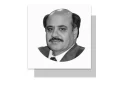
FEDERAL Minister, Dr Musadik Malik, was widely expected to deliver and he lived up to expectations during his India visit where he made a visible impact on the public opinion in the host country due to his argumentative remarks, sobriety and unprovoked behaviour. Observers and social media commentators have praised Malik’s participation at the Shanghai Cooperation Organization (SCO) Civilizational Dialogue Forum in New Delhi as dignified and articulate in the backdrop of continued tension between the two countries, which are, otherwise, not on talking terms because of deep-rooted mistrust and acrimonious relationship.
While Pakistan made a calculated choice in deciding to send Musadik Malik to represent Pakistan at the multilateral forum, Indian opposition politicians, including leaders from the Congress, Samajwadi Party and NCP (SP), criticized the Indian Government over allowing a Pakistani Minister to attend the event amid strained ties and past remarks by Malik regarding the Indus Waters Treaty. Contrary to such biased opinion, saner elements within India itself acknowledged that Pakistan made a right choice in nominating a personality like Dr Musadik to represent the country at a forum in India. This was based on his actual performance as highlighted by his thought-provoking presentation at the forum and media-interaction on the sidelines of the event. His nomination for the purpose was surely based on merit as Dr Musadik proved his mettle during his multifarious responsibilities in the country. He comes fully prepared with arguments and facts and that is what he did in India despite hostile questions by the local media. It is a reality that he put across Pakistan’s case in a persuasive manner in India, which will surely help crystallize thinking on related issues.
Some media-persons tried to entangle him into controversies by seeking his past comments on Pakistan’s water rights but he disappointed them by saying he was in India for a specific purpose and he can talk on other topics when invited to visit for the purpose. There is a fashion in India to malign Pakistan on the issue of terrorism and, in fact, it was this tendency that brought the two countries to a war in May 2025. India, without going through investigations, raised accusing fingers towards Pakistan after the Pahalgam terrorist incident and decided to launch so-called pre-emptive strikes in Pakistan and Azad Jammu & Kashmir. In this backdrop, Dr Malik called for a regional mechanism to examine allegations of militant activity through evidence-sharing, saying countries must work together to address security threats rather than engage in exchange of accusations. Malik said Pakistan wanted a transparent mechanism through which both sides could present their respective evidence rather than use allegations for propaganda. He maintained that dialogue did not mean agreement or a retreat from either country’s position. He also reminded Indians that Pakistan had suffered thousands of casualties from militancy and continued to lose people to attacks, arguing that countries across the region, including Iran, Afghanistan and India, faced similar security challenges.
In fact, Pakistan has a firm position on issues, including terrorism and the Indus Waters Treaty, but remained open to discussions if the other side demonstrated sincerity. Pakistan has also repeatedly urged India to sort out differences through discussions and dialogue but India avoided talks and relied instead on pressure tactics like suspension of Indus Water Treaty and ‘pre-emptive’ strikes on the pretext of Pakistan sponsoring terrorism. Malik rightly pointed out that if India has any evidence, Pakistan too has evidence and the logic demands the two countries, instead of indulging in exchange of allegations, should share the evidence and find out solutions based on firm evidence. Dr Musadik deserves appreciation for meaningfully representing Pakistan at the moot and this proves the country gains if foreign trips are decided purely on merit.