




ISLAMABAD – Billions of dollars flow through Pakistan’s aviation industry every year, but massive financial mystery raised serious questions over where the money goes.
Aircraft Owners and Operators Association (AOOA) flagged alleged $2.4 billion annual revenue gap, claiming that offshore payment channels may be keeping substantial airline ticket sales outside Pakistan’s documented financial records. The revelations have sparked demands for a five-year forensic tax audit of airlines operating in the country.
The massive discrepancy in Pakistan’s airline ticketing business sparked concerns over offshore financial transactions, with Aircraft Owners and Operators Association (AOOA) calling for an urgent government investigation into how billions of dollars generated through aviation activities are being handled outside the country’s documented financial channels.
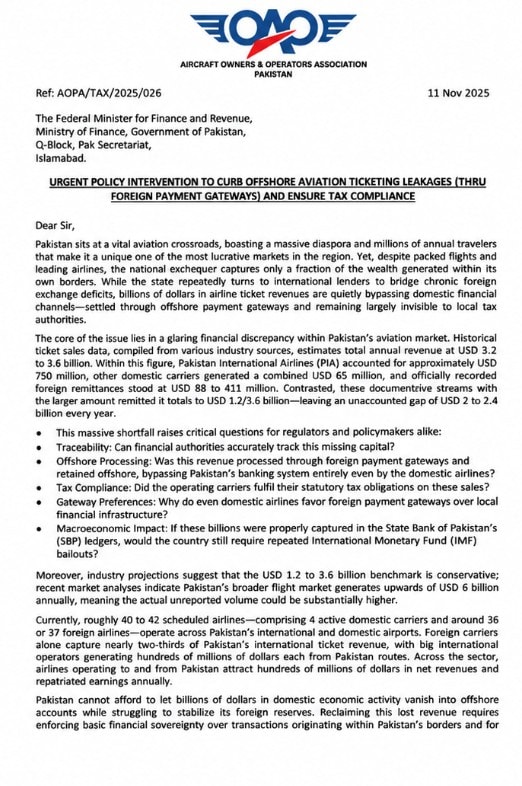
In a letter to Federal Minister for Finance and Revenue, the association raised alarm over the massive difference between estimated airline ticket sales and revenues reflected in selected official financial records. The association claims that Pakistan’s aviation market generates between $3.2 billion and $3.6 billion annually, yet only around $1.1 billion is identifiable through the financial streams examined in its assessment, leaving billions of dollars in transactions requiring further scrutiny.
The allegations have brought offshore payment gateways, foreign airlines and the aviation industry’s tax compliance practices into the spotlight.
The South Asian nation is home to millions of international travelers, including vast overseas Pakistani community that generates demand for flights to the Middle East, Europe, North America and other destinations. Despite this substantial passenger market, AOOA argues that the country’s financial reporting systems do not adequately reflect the scale of aviation ticketing activity.
Pakistan International Airlines accounts for $750 million in annual revenue, while other domestic carriers collectively generate an estimated $65 million. Meanwhile, documented remittances associated with foreign airlines range between $80 million and $221 million.
Even after using the higher foreign remittance figure, the combined amount reaches approximately $1.116 billion, significantly below the aviation market’s estimated annual value. The calculation points to a gap of approximately $2.1 billion to $2.5 billion, which the association generally describes as a $2 billion to $2.4 billion discrepancy.
At the heart of the controversy is the growing use of foreign payment platforms and overseas banking arrangements for airline ticket purchases. AOOA suspects that substantial ticket sales connected to Pakistan may be processed through international financial systems without corresponding visibility in domestic banking and taxation records.
The association questioned whether international carriers are collecting payments through offshore gateways and retaining the proceeds abroad instead of processing them through locally monitored channels. It also raised concerns that certain domestic operators could be using similar arrangements, potentially making it more difficult for Pakistani authorities to track revenues and verify tax obligations.
The issue becomes more significant considering the number of carriers serving Pakistan. According to the association’s assessment, 40 to 42 scheduled airlines operate in the country, including around four active domestic airlines and 36 to 37 foreign carriers. International airlines command a substantial share of the aviation market, with AOOA estimating that foreign operators account for nearly two-thirds of international ticket revenue in some segments.
The association believes this dominance makes it essential for authorities to examine how ticket payments are collected, settled, recorded and taxed. It has also pointed to broader industry projections suggesting that the overall flight market could be worth as much as $6 billion annually.
The association linked alleged financial reporting gap with Pakistan’s longstanding foreign exchange challenges and dependence on external financial assistance. In its communication, AOOA questioned whether stronger oversight of aviation-related financial flows could have helped improve Pakistan’s foreign exchange position and reduced some pressure associated with International Monetary Fund support.
The argument highlights broader concern over whether Pakistan is fully benefiting from economic activity connected to its aviation market. However, not every dollar earned through international airline ticket sales is necessarily required to enter Pakistan’s banking system or foreign exchange reserves.
Amid these concerns, the aviation association urged the government to launch a comprehensive five-year forensic examination of airline ticket revenues and taxation practices. The proposed investigation would focus on the financial activities of domestic and international carriers, particularly their use of offshore payment gateways and overseas settlement systems.
The association wants authorities to determine whether ticket sales originating from Pakistan are properly recorded, whether applicable taxes are being paid and whether airlines are meeting domestic financial reporting requirements. It also called for stronger coordination between the Finance Ministry, Federal Board of Revenue and relevant financial regulators to improve transparency across the aviation sector.


