




ISLAMABAD – From earning less than Rs4000 a month in 2000 to Rs50,000 in 2025, Pakistan’s Middle Class witnessed major changes in incomes over past quarter-century. But behind the rising numbers lies different story of inflation, low purchasing power and struggling masses to survive.
The findings, based on Pakistan Bureau of Statistics (PBS) data shows mixed picture of the country’s economic progress, showing expanding middle-income population alongside persistent inflationary pressures, currency depreciation and fluctuations in real earnings. The number of Pakistanis earning more than $300 per month increased from just 900,000 in 1999 to 15.2 million in 2025, showing nearly 17 times more growth.
Yet the figure remains below record 16.2 million recorded in 2018, showing that country’s middle-income segment has not fully regained its previous strength under the study’s definition.
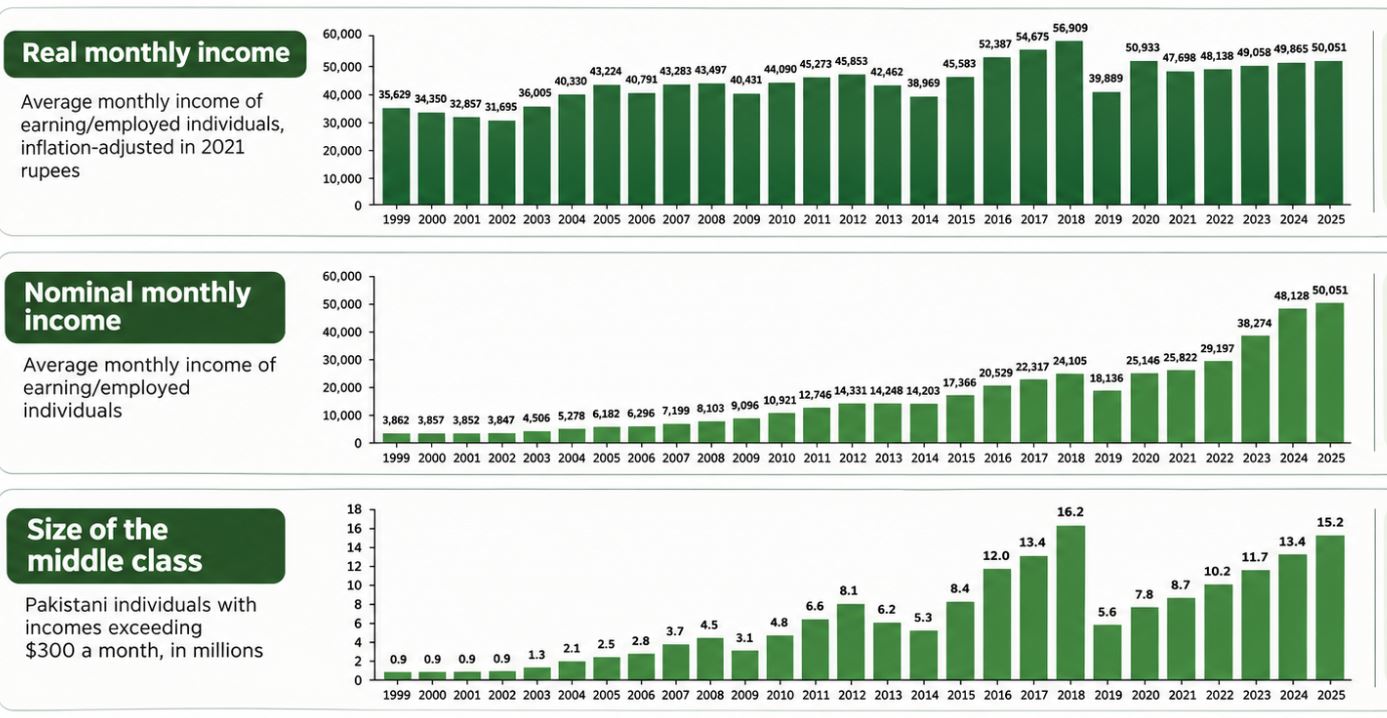
The data reveal a dramatic journey for Pakistan’s middle class, marked by periods of rapid expansion followed by sudden economic setbacks. In 1999, approximately 900,000 Pakistanis earned more than $300 a month, a figure that remained unchanged through 2002. The middle-income population gradually expanded to 1.3 million in 2003, 2.1 million in 2004 and 4.5 million by 2008. However, economic pressures pushed the figure down to 3.1 million in 2009.
Growth resumed in subsequent years, taking the estimated population to 4.8 million in 2010, 6.6 million in 2011 and 8.1 million in 2012. Another downturn reduced the number to 6.2 million in 2013 and 5.3 million in 2014 before a strong recovery began. By 2015, the middle-class population had reached 8.4 million, climbing to 12 million in 2016, 13.4 million in 2017 and a record 16.2 million in 2018.
Pakistan’s estimated middle-income population plunged nearly 65 percent to just 5.6 million in 2019, marking the sharpest annual decline in the series. The setback coincided with a period of economic instability, rupee depreciation, rising inflation and external financing pressures.
In all these years, exchange-rate movements contributed to this decline. Falling below $300 in monthly earnings does not necessarily mean an individual became unemployed or experienced an equivalent reduction in rupee income. The recovery began in 2020, when the number increased to 7.8 million, followed by 8.7 million in 2021 and 10.2 million in 2022.
It rose further to 11.7 million in 2023, 13.4 million in 2024 and 15.2 million in 2025. Despite this sustained improvement, the estimated population remains one million below its 2018 high. Average monthly income among earning or employed individuals stood at Rs3,862 in 1999, gradually rising to Rs5,278 in 2004 and Rs6,182 in 2005.
The figure reached nearly Rs9,000 in 2009, Rs14,000 in 2012 and Rs17,000 in 2015. By 2018, average monthly earnings had increased to Rs24,000 before falling to Rs18,000 in 2019. Income recovered to Rs25,146 in 2020 and Rs25,822 in 2021, climbing to Rs29,197 in 2022.
In 2025, the average climbed to Rs50,000 per month, the highest nominal income recorded in the supplied historical series. Although this shows 13x increase since 1999, the growth must be viewed against changes in the cost of living. Higher earnings do not mean greater financial security when prices of essential commodities, electricity, housing, transport and healthcare rise simultaneously.
An inflation-adjusted income comparison presents grim picture. Measured in constant 2021 rupees, average individual monthly income stood at Rs35,629 in 1999 before declining to Rs31,695 in 2002.
Real earnings recovered to Rs43,224 in 2005 and Rs45,853 in 2012, although periods of economic weakness continued to interrupt progress. By 2014, the figure had slipped to Rs38,969 before entering another expansionary phase. Inflation-adjusted monthly income increased to Rs52,387 in 2016, Rs54,675 in 2017 and reached a peak of Rs56,909 in 2018. However, the figure dropped sharply to Rs39,889 in 2019 before recovering to Rs50,933 in 2020.
In subsequent years, the series shows a relatively modest improvement, increasing from Rs47,698 in 2021 to Rs48,138 in 2022, Rs49,058 in 2023 and Rs49,865 in 2024.
The 2025 reading stands at Rs50,051, approximately 12 percent below the 2018 peak. These figures suggest that real income recovery has been considerably weaker than the rise in nominal salaries might indicate.
The broader household picture reinforces concerns about Pakistan’s rising cost of living. According to PBS Household Integrated Economic Survey, average monthly household income increased from Rs41,545 in 2018–19 to Rs82,179 in 2024–25, reflecting nominal growth of approximately 98 percent.
However, household consumption expenditure also increased substantially, rising from Rs37,159 to Rs79,150 during the same period. This means households were spending considerably more on their daily requirements despite reporting higher earnings.
The numbers draw complex economic challenges facing Pakistan, where higher earnings, expanding consumer markets and middle-class recovery coexist with persistent concerns over purchasing power. The recovery from 5.6 million middle-income individuals in 2019 to 15.2 million in 2025 represents a substantial improvement, but it does not automatically indicate that financial conditions have strengthened equally across all income groups.
Long-term prosperity depends on stable economic growth, productive employment, improved wages and greater protection against inflation and currency volatility. Pakistan’s average nominal monthly income may have crossed Rs50,000, but the deeper economic question remains whether ordinary citizens can afford more than they could several years ago.


