ISLAMABAD – Pakistan achieved defence breakthrough by successfully testing its first indigenous Fa’az air-to-air missile with 100KM range. As an advanced 180KM variant remains under development, the new weapon could strengthen Pakistan’s aerial combat capabilities amid growing military competition with India.
The missile features advanced guidance technology designed to strike enemy aircraft beyond pilot’s visual range. Its development comes amid intensifying competition between Pakistan and India to acquire increasingly powerful air combat weapons.
While the current missile reportedly offers range of approximately 100 kilometres, defence experts say a more advanced variant, Fa’az-II, could potentially exceed 180 kilometres, opening the door to a new generation of Pakistani missiles.

Fa’az is Beyond Visual Range (BVR) missile, allowing fighter aircraft to engage aerial targets without requiring pilots to see them directly. The missile has two main variants, each employing a different targeting system. The first uses an Imaging Infrared (IIR) seeker capable of producing thermal images of enemy aircraft instead of merely tracking heat signatures.
This sophisticated technology could make the weapon more resistant to flares used by enemy pilots to confuse heat-seeking missiles. The missile’s infrared seeker reportedly identifies targets at distances of 40 to 45 kilometres. During the initial flight phase, guidance comes from the launching fighter jet’s radar. As Fa’az approaches its target, its onboard seeker takes control of the final engagement.
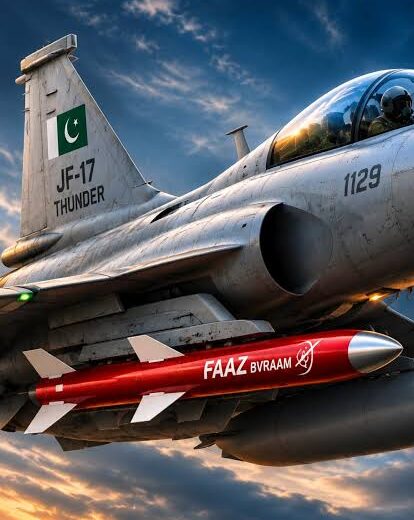
The second variant features Active Radar Homing (ARH) technology, allowing the missile to independently locate and track targets using its own miniature radar at approximately 20 to 25 kilometres, and is viewed as expanding family of missiles rather than a single weapon.
Fa’az-II, the upgraded missile will be capable of engaging targets more than 180 kilometres away. The advanced weapon may incorporate a dual-pulse rocket motor, designed to improve propulsion and energy management during flight. Pakistan’s Air Weapons Complex (AWC) has also reportedly developed a dual-thrust rocket motor for the existing Fa’az platform.
This technology has enabled engineers to explore a surface-launched configuration known as Fa’az SL, potentially extending the programme beyond fighter aircraft. Experts believe such developments could eventually support both air-to-air and surface-to-air defence systems.
For decades, Pakistan has depended heavily on American and Chinese technology to equip its fighter aircraft. Its F-16 fleet operates American AIM-120 missiles, while JF-17 and J-10 fighters carry Chinese PL-series weapons. Chinese PL-15E remains among the Pakistan Air Force’s most advanced long-range air-to-air missiles.

Although the existing Fa’az is not considered a direct competitor to the PL-15E in overall capability, its domestic development represents an important strategic shift.
Earlier JF-17 Block I and II aircraft faced limitations involving radar capabilities, payload and propulsion, while Block III introduced advanced AESA radar and improved avionics. Pakistan is now reportedly pursuing domestically developed Gallium Nitride (GaN) radar technology through the National Aerospace Science and Technology Park (NASTP).
Previously, technical restrictions surrounding the integration of Chinese missiles reportedly influenced Pakistan’s selection of the KLJ-7A radar instead of alternative Western systems such as the Grifo-E. Developing compatible radar and missile technologies domestically could provide Pakistani engineers with greater freedom to upgrade aircraft without relying entirely on foreign suppliers.
With older F-7 and Mirage fighters gradually leaving service, the JF-17 is expected to play an increasingly important role in Pakistan’s future combat fleet.
The latest development comes as Pakistan and India continue investing in longer-range aerial weapons. Delhi operates European-made Meteor missile on its Rafale fighters and is expanding its indigenous Astra programme, with future variants intended for platforms including the Tejas fighter.
The rivalry intensified following the 2019 aerial confrontation and renewed military hostilities in May 2025. During last year confrontation, Pakistani military assessments credited integrated radar, fighter aircraft and missile systems with enabling engagements involving Chinese PL-15E weapons.
Experts argue that modern aerial combat increasingly depends on integrated detection, tracking and engagement networks rather than fighter aircraft performance alone. India’s progress in ramjet propulsion presents another challenge, as such engines can help missiles sustain speed and energy over longer distances.
Potential technological cooperation with Türkiye could become another important factor in Pakistan’s missile ambitions. Although no direct connection has been established between Fa’az and Türkiye’s Gökdoğan missile programme, analysts see opportunities for collaboration.