WASHINGTON – Its elections day in US that could redraw Washington’s political balance and determine how much room President Donald Trump has to advance his agenda during his remaining two years in office. The key questions are whether Democrats can secure 218 House seats, achieve the net gains required for Senate control and expand their number of governorships.
Key Senate contests are in Iowa, Kansas, Maine, Ohio, Texas and Alaska, alongside Democrats’ defence of Michigan. Governor races in Georgia, Nevada, Ohio, Wisconsin and Kansas will provide a separate measure of how the parties perform at state level. Midterm polls cover every seat in House of Representatives, more than a third of the Senate and 36 governorships. Democrats are seeking to overturn Republican control of Congress, while Republicans are fighting to preserve their governing advantage.
What Are Americans Voting For?
Midterm elections take place halfway through a president’s four-year term. Although the presidency itself is not on the ballot, the results determine who controls Congress and numerous state governments.
| Office | Seats contested |
| House of Representatives | 435 |
| US Senate | 35 |
| State governors | 36 |
| Other state and local offices | Varies |
| Ballot measures | Varies |
Senate elections include special contests in Florida and Ohio. Republicans are defending 22 of the contested Senate seats, while Democrats are defending 13. Among the governorships being contested, each party holds 18.

| Office | Seats |
|---|---|
| House | 435 |
| Senate | 35 |
| Governors | 36 |
Midterm polls mean alot for Trump as Congressional control will influence whether Trump can secure support for new legislation or must negotiate with an opposition-led chamber. Democrats would gain greater authority over committee agendas and investigations if they capture either chamber. A Republican victory would preserve a more favourable environment for the administration’s legislative priorities.
All 435 House seats are being contested. With every seat filled, a party needs 218 seats for a majority. The supplied election briefing describes Democrats as strong favourites, citing projected Democratic totals of roughly 230–242 seats and probabilities of victory around 90–95% or higher. Those ranges come from unspecified forecasts and should not be treated as a single agreed projection.
Senate Battle
Republicans entered Election Day with 53 Senate seats, compared with 47 held by Democrats and independents aligned with them. Democrats need a net gain of four seats to reach 51.
| State | Candidates | Assessment |
|---|---|---|
| Alabama | Barry Moore, R, vs Everett Wess, D | Safe R |
| Alaska | Dan Sullivan, R, vs Mary Peltola, D | Toss-up/Lean D |
| Arkansas | Tom Cotton, R, vs Hallie Shoffner, D | Safe R |
| Colorado | John Hickenlooper, D, vs Mark Baisley, R | Safe D |
| Delaware | Chris Coons, D, vs Michael Katz, R | Safe D |
| Florida — special | Ashley Moody, R, vs Angie Nixon, D | Likely R |
| Georgia | Jon Ossoff, D, vs Mike Collins, R | Likely D |
| Idaho | Jim Risch, R; opponent unspecified | Safe R |
| Illinois | Juliana Stratton, D, vs Don Tracy, R | Safe D |
| Iowa | Ashley Hinson, R, vs Josh Turek, D | Toss-up |
| Kansas | Roger Marshall, R, vs Adam Hamilton, D | Toss-up/Lean D |
| Kentucky | Andy Barr, R, vs Charles Booker, D | Safe R |
| Louisiana | Julia Letlow, R, vs Jamie Davis, D | Likely R |
| Maine | Susan Collins, R, vs Troy Jackson, D | Lean/Tilt D |
| Massachusetts | Ed Markey, D, vs John Deaton, R | Safe D |
| Michigan | Abdul El-Sayed, D, vs Mike Rogers, R | Lean D |
| Minnesota | Peggy Flanagan, D, vs Michele Tafoya, R | Lean/Likely D |
| Mississippi | Cindy Hyde-Smith, R; opponent unspecified | Likely R |
| Montana | Candidates not fully identified | Likely/Safe R |
| Nebraska | Pete Ricketts, R, vs Dan Osborn, independent | Lean R |
| New Hampshire | Candidates not identified | Lean/Likely D |
| New Jersey | Cory Booker, D; opponent unspecified | Safe D |
| New Mexico | Ben Ray Luján, D; opponent unspecified | Safe D |
| North Carolina | Roy Cooper, D, vs Michael Whatley, R | Likely D |
| Ohio — special | Sherrod Brown, D, vs Jon Husted, R | Lean D/Toss-up |
| Oklahoma | Candidates not identified | Safe R |
| Oregon | Jeff Merkley, D; opponent unspecified | Safe D |
| Rhode Island | Jack Reed, D; opponent unspecified | Safe D |
| South Carolina | Darline Graham, R, highlighted | Lean R |
| South Dakota | Candidates not identified | Safe R |
| Tennessee | Candidates not identified | Safe R |
| Texas | Ken Paxton, R, vs James Talarico, D | Toss-up/Lean D |
| Virginia | Mark Warner, D; opponent unspecified | Safe D |
| West Virginia | Candidates not identified | Safe R |
| Wyoming | Candidates not identified | Safe R |
R = Republican; D = Democrat. Ratings above reproduce the briefing’s assessments rather than a uniform forecasting model.
Iowa, Kansas, Maine, Ohio, Texas and Alaska are important potential Democratic gains, while Michigan is a seat Democrats must defend. Kalshi’s published comparison shows several of these races rated as toss-ups by Cook Political Report even when market prices favour Democrats—illustrating the difference between analyst ratings and betting probabilities.
Prediction Markets
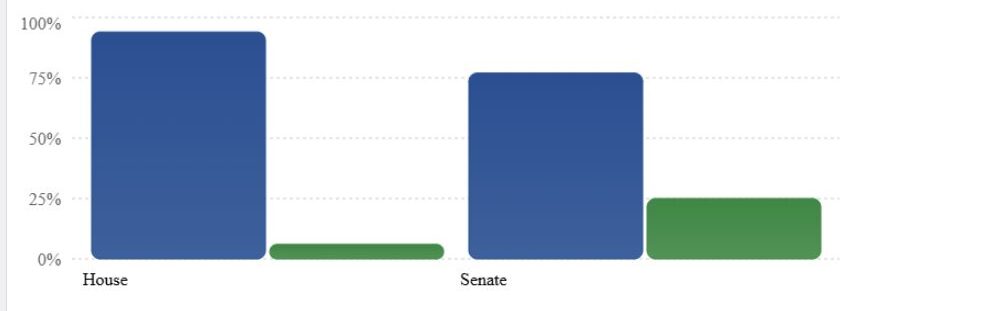
The supplied material records the following Kalshi snapshot at 10:17 a.m. Eastern Time on November 3, equivalent to 8:17 p.m. Pakistan time.
| Chamber | Democratic probability | Republican probability |
|---|---|---|
| House | 94% | 6% |
| Senate | 77% | 25% |

Market Expectations
| Chamber | Democrats | Republicans |
|---|---|---|
| House | 94 | 6 |
| Senate | 77 | 25 |
A party with a 77% probability of winning Senate control is not expected to win 77% of votes or 77 Senate seats. The briefing also gives the following trading-volume
Governors Battle
Thirty-six states are electing governors. Republicans held 26 governorships nationally before the election, while Democrats held 24. The supplied briefing suggests Democratic gains could bring their total to around 27, although it does not identify the model behind that estimate. The election schedule and starting party balance are confirmed by Ballotpedia.
High-Profile Governor Contests
| State | Candidates | Outlook |
|---|---|---|
| Georgia | Keisha Lance Bottoms, D, vs Rick Jackson, R | Toss-up |
| Ohio | Amy Acton, D, vs Vivek Ramaswamy, R | Lean D |
| Nevada | Aaron Ford, D, vs Joe Lombardo, R | Toss-up |
| Texas | Gina Hinojosa, D, vs Greg Abbott, R | Lean/Likely R |
| Florida | Byron Donalds, R; Democratic opponent unspecified | Lean/Likely R |
| Wisconsin | David Crowley, D; Republican opponent unspecified | Lean D |
| Iowa | Rob Sand, D; Republican opponent unspecified | Lean/Likely D |
| Oregon | Tina Kotek, D, vs Christine Drazan, R | Lean/Likely D |
| Arizona | Katie Hobbs, D, highlighted | Likely D |
| Alaska | Jonathan Kreiss-Tomkins, D, highlighted | Democratic advantage in some forecasts |
| Kansas | Cindy Holscher, D, vs Ty Masterson, R | Lean R/Toss-up |
| New York | Kathy Hochul, D, highlighted | Safe D |
State-by-State Governor Outlook
The following table reorganises the supplied forecasts. Pennsylvania and Tennessee were incorrectly marked as having no governor election in the original; both are included below, with their ratings drawn from Decision Desk HQ.
| State | Governor forecast | State | forecast |
|---|---|---|---|
| Alabama | Safe/Likely R | Alaska | Lean/Likely D |
| Arizona | Likely D | Arkansas | Safe R |
| California | Safe D | Colorado | Safe D |
| Connecticut | Safe D | Florida | Lean/Likely R |
| Georgia | Toss-up/slight D edge | Hawaii | Safe D |
| Idaho | Safe R | Illinois | Safe D |
| Iowa | Lean/Likely D | Kansas | Lean R/Toss-up |
| Maine | Likely/Safe D | Maryland | Safe D |
| Massachusetts | Safe D | Michigan | Likely D |
| Minnesota | Safe/Likely D | Nebraska | Likely R |
| Nevada | Toss-up | New Hampshire | Likely R |
| New Mexico | Likely/Safe D | New York | Safe D |
| Ohio | Lean D | Oklahoma | Safe/Likely R |
| Oregon | Lean/Likely D | Pennsylvania | Safe D — DDHQ |
| Rhode Island | Likely D | South Carolina | Likely R |
| South Dakota | Safe R | Tennessee | Likely R — DDHQ |
| Texas | Lean/Likely R | Vermont | Lean R/Toss-up |
| Wisconsin | Lean/Likely D | Wyoming | Safe R |
Over dozen states without governor elections in 2026 are Delaware, Indiana, Kentucky, Louisiana, Mississippi, Missouri, Montana, New Jersey, North Carolina, North Dakota, Utah, Virginia, Washington and West Virginia. There are no Senate elections this year in Arizona, California, Connecticut, Hawaii, Indiana, Maryland, Missouri, Nevada, New York, North Dakota, Pennsylvania, Utah, Vermont, Washington or Wisconsin.
Polling ends gradually across America’s time zones. The first closures begin at 6 p.m. Eastern Time in parts of Indiana and Kentucky, with the final Alaska closures at 1 a.m. Eastern Time.
Initial returns arrive after polls close, but the time needed to establish a winner varies by state and by the closeness of the contest. Mail-heavy states may continue counting substantial numbers of ballots after election night.
Stay updated with our page for more updates…
US midterm elections underway as Democrats eye House majority