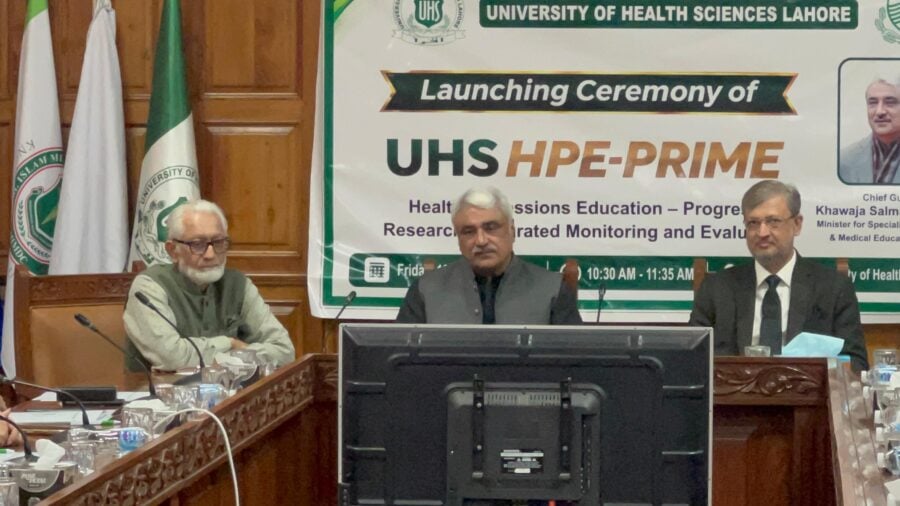

The University of Health Sciences (UHS) has introduced a province-wide digital platform, PRIME, to streamline the monitoring and assessment of medical education, clinical training and professional competencies across Punjab.
Provincial Minister for Specialized Healthcare and Medical Education Khawaja Salman Rafique inaugurated the Health Professions Education – Progress, Research, Integrated Monitoring and Evaluation (HPE-PRIME) platform at a ceremony held at UHS on Friday.
The initiative aims to enhance transparency, accountability and quality assurance through digital monitoring and competency-based assessments.
The first phase will cover approximately 3,300 postgraduate medical and dental trainees enrolled in MS, MD and MDS programmes at 33 institutions across Punjab. Around 1,100 supervisors will also be registered on the platform.
PRIME will replace traditional paper-based logbooks with digital records documenting clinical cases, procedures, attendance, rotations, research activities and workplace-based assessments. Supervisors will be able to verify trainees’ activities, provide feedback and track their progress, while institutional dashboards will help UHS monitor training standards and identify shortcomings.
Addressing the ceremony, Rafique emphasised that modern healthcare facilities must be supported by a competent workforce capable of making sound clinical decisions and delivering quality patient care.
He said medical education should focus not merely on awarding degrees or increasing the number of doctors but on producing skilled professionals equipped to make appropriate clinical decisions and provide effective treatment.
The minister praised UHS for introducing the digital monitoring system, expressing confidence that it would improve postgraduate training. He also acknowledged the contributions of the Directorate of Postgraduate Studies, faculty members and the university’s IT team.
Rafique noted that UHS oversees undergraduate and postgraduate training at around 230 institutions, making systematic monitoring, reliable data and regular competency assessments essential.
He said information generated through PRIME would help identify training gaps, support evidence-based policymaking and improve the performance of supervisors and institutions.
UHS Vice Chancellor Maj Gen (Retd) Prof. Sohail Sabir said the platform would shift health professions education from conventional record-keeping towards a system focused on demonstrated clinical competence and verified professional skills.
According to Prof. Sohail Sabir, the second phase will extend PRIME to undergraduate MBBS and BDS programmes and house-job training, covering approximately 33,875 students and house officers across 60 medical and dental colleges.
The third phase will incorporate Nursing, Pharmacy and Allied Health Sciences programmes, bringing around 31,734 students from 180 institutions into the system.